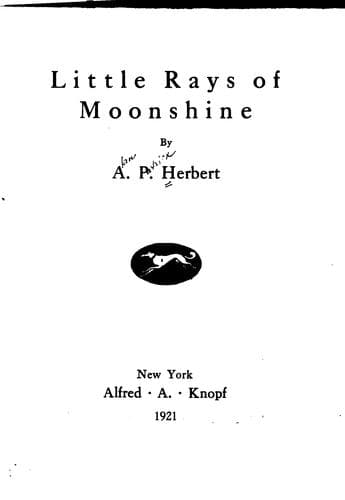
Little rays of moonshineHerbert, A. P. (Alan Patrick)
General
Little rays of moonshine
Herbert, A. P. (Alan Patrick)
English essays -- 20th century; English wit and humor
It is no wonder that in some circles Mr. Bradshaw holds a position
comparable only to the position of Homer. I once knew an elderly
clergyman who knew the whole of Mr. Bradshaw’s book by heart. He could
tell you without hesitation the time of any train from anywhere to
anywhere else. He looked forward each month to the new number as other
people look forward to the new numbers of magazines. When it came he
skimmed eagerly through its pages and noted with a fierce excitement
that they had taken off the 5.30 from Larne Harbour, or that the 7.30
from Galashiels was stopping that month at Shankend. He knew all the
connections; he knew all the restaurant trains; and, if you mentioned
the 6.15 to Little Buxton, he could tell you offhand whether it was a
Saturdays Only or a Saturdays Excepted.
This is the exact truth, and I gathered that he was not unique. It
seems that there is a Bradshaw cult; there may even be a Bradshaw club,
where they meet at intervals for Bradshaw dinners, after which a paper
is read on “Changes I have made, with some Observations on Salisbury.”
I suppose some of them have first editions, and talk about them very
proudly; and they have hot academic discussions on the best way to
get from Barnham Junction to Cardiff without going through Bristol.
Then they drink the toast of “The Master” and go home in omnibuses. My
friend was a schoolmaster and took a small class of boys in Bradshaw;
he said they knew as much about it as he did. I call that corrupting
the young.
But apart from this little band of admirers I am afraid that the book
does suffer from neglect. Who is there, for example, who has read
the “Directions” on page 1, where we are actually shown the method
of reading tentatively suggested by the author himself? The odinary
reader, coming across a certain kind of thin line, lightly dismisses
it as a misprint or a restaurant car on Fridays. If he had read the
Preface he would know that it meant a SHUNT. He would know that a SHUNT
means that passengers are enabled to continue their journey by changing
into the next train. Whether he would know what that means I do not
know. The best authorities suppose it to be a poetical way of saying
that you have to change--what is called an euphemism.
Public-domain text, read in full here on John Shaqi.
Reviews
Reviews
No reviews yet
Be the first to share your thoughts on this work.
Join the Discussion
Join the discussion
Sign in to leave a comment or review.
Sign InorCreate an account