In the case of the two editors, both from early childhood found their
inspiration in Jo. One, patterning after her idol, sought success in a
stage career, beginning to "act" before a mirror, with a kitchen apron
for a train and a buttonhook for a dagger. The other, always with a
pencil in hand, first copied Jo by writing "lurid tales" for the weekly
sensation papers, and later emerged into Newspaper Row.
It was more than a year after the success of "Little Women" as a play
had become a part of theatrical history that they visited the scenes
hallowed by the memories of the Little Women. They wished to see Concord
together, so they made a Sentimental Journey to the House of Alcott.
The sun was shining, and the air was crisp--just such a day as Miss
Alcott described in the Plumfield harvest home, the last chapter in
"Little Women." They spent hours in Orchard House, touching reverently
the small personal effects of Louisa M. Alcott, seeing the shelf
between the windows in that little upper room, where she wrote and
dreamed. They even climbed to the garret and wondered which window was
her favorite scribbling seat, with a tin kitchen for her manuscripts, a
pile of apples for her refreshment, and Scrabble, the bewhiskered rat,
for her playfellow.
Through the woods back of Orchard House they followed the winding
pathway to the Hall of Philosophy, half hidden among the trees, where
Bronson Alcott had his Conversations, where Emerson and Thoreau were
often heard, and the most intellectual debates of the century took
place.
At sunset they visited Sleepy Hollow, the resting place of the Alcotts,
with Emerson, Thoreau, and Hawthorne close by--a goodly company,
neighbors still as they were for so many years when they made Concord
America's literary shrine.
Evening came, and the two pilgrims read together the Alcott journals and
letters. The ink was faded, the quaint, old-fashioned writing was hard
to decipher, but, beginning with a letter to Louisa written by Bronson
Alcott when his daughter was seven years old, they read on until the
dawn.
Only one result could be expected from such an experience. They asked
permission to publish the letters and such portions of the journals as
would most completely reveal the rare spiritual companionship existing
between the Alcott parents and children. And, asking, they were refused,
because of a feeling that the letters and journals were intimate family
records, to be read, not by the many, but by the few. This same
sentiment withheld the dramatization of "Little Women" for many years.
"You forget," they argued, holding fast to the dimly written pages,
"that Bronson Alcott and Louisa Alcott are a part of America's literary
heritage. They belong to the nation, to the world, not alone to you."
This course of reasoning finally prevailed, but not without many months
of waiting. And thus, with the consent of the Alcott heirs, the book of
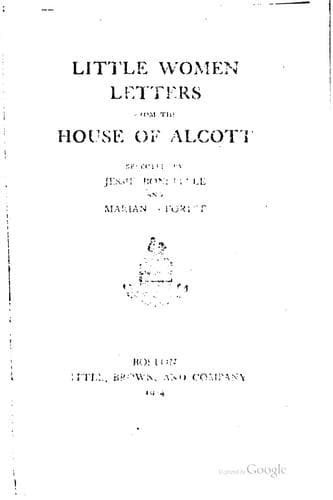
"Little Women Letters from the House of Alcott" came to be.
Public-domain text, read in full here on John Shaqi.
Reviews
Reviews
No reviews yet
Be the first to share your thoughts on this work.
Join the Discussion
Join the discussion
Sign in to leave a comment or review.
Sign InorCreate an account