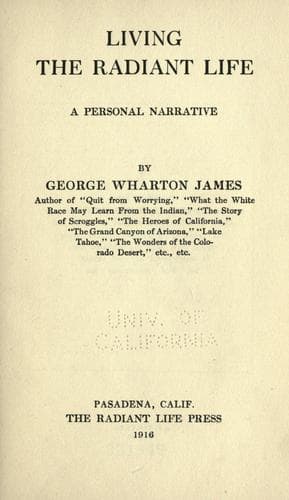
Living the Radiant Life: A Personal NarrativeJames, George Wharton
Religion
Living the Radiant Life: A Personal Narrative
James, George Wharton
Conduct of life
Stephen Langton and the barons of England protested against the
tyrannical power of King John. They did so at the peril of their heads.
Yet they were possessed of this spirit of contemporaneous rebellion, and
they fought against John and won from him that great charter of the
liberties of men, that has been the basis of all proclamations of
freedom ever since.
Cromwell, Hampden, Pym, Milton, and the other great commoners and
democrats of England were in a state of contemporaneous protest and
rebellion against the undue pretensions of King Charles I. Their
protests might have cost them their lives--yet they protested. And they
won a victory that has made republics possible throughout all time.
So with the leaders of the French Revolution. There were many awful and
bloody events connected with that great act of contemporaneous protest,
but that the ultimate outcome upon mankind has been good most
true-hearted thinkers agree. Yet the protests were made by the earlier
agitators under great danger.
When Patrick Henry, Franklin, Jefferson, Adams, Washington, and the
other American revolutionists protested against King George's tyranny,
and when the noble band met at Philadelphia and signed the Declaration
of Independence, they knew they did it at the peril of their lives--yet
they protested and won for mankind the victory that Joaquin Miller calls
"Time's burst of Dawn."
Had Langton, Cromwell, the French Revolutionists, Washington, and the
signers of the Declaration of Independence failed, they would all have
forfeited their lives for their temerity. It was an act of great moral
courage to rebel.
When Galileo rebelled against the dictum of the ecclesiastic authorities
in regard to the movement of the earth, it meant his imprisonment, yet
he rebelled and thus ushered in a new day of advancement in astronomical
knowledge. Darwin did the same. Both men required daring and courage,
yet they did not hesitate or falter.
There are evils to-day that should be fought; fashions, customs,
entrenched wrongs in existence _now_ against which manly men are called
to be in contemporaneous rebellion. Those of us who live to-day are
reaping great and blessed privileges, freedom, liberties, won for us as
the result of the protests, rebellions, warfares of the moral heroes of
the past; so should we further the progress of the world by protesting
and fighting the existing wrongs, in order that future generations may
be freer than we are, and may push on still further the glorious chariot
of human progress.
Public-domain text, read in full here on John Shaqi.
Reviews
Reviews
No reviews yet
Be the first to share your thoughts on this work.
Elsewhere in the archive
Join the Discussion
Join the discussion
Sign in to leave a comment or review.
Sign InorCreate an account