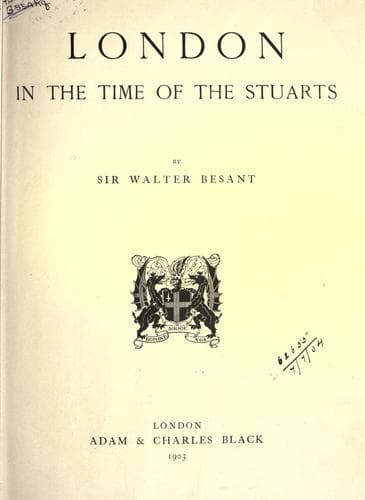
London (England) -- History -- 17th century; London (England) -- Social life and customs -- 17th century
We have now to consider the influence of James, not on the country
at large, where opinion was slow in coming to a head, so much as in
the City, where, with 100,000 gathered closely together, and that
within hearing of Whitehall, suspicion and jealousy, once awakened,
became rapidly opinion, and opinion became conviction, and the settled
conviction of the City, once known and formulated, proved the most
important weapon of all those forged by the pedantry and obstinacy
of James, and the equal obstinacy and wrongheadedness of Charles. In
other words, it is necessary in this place to show, if possible, that
in a closer sense than is usual the years 1603–1625 were a preparation
for the appeal to arms, by which the liberties of the country were
secured. I prepare, therefore, to pass in very brief review some of the
leading political events of the time, in order to show how the City was
affected by them.
To begin with, the City was fiercely Protestant. The Catholic reaction,
which had stayed the spread of Continental Protestantism, only made
England more doggedly Protestant. That a new life had been imparted
to the Catholic Church by the Jesuits and the new orders made the
Englishman only the more hostile to a church which threatened his
nationality, his liberties, everything that he held most sacred. Again,
to the Protestant spirit belonged the right of free thought and free
doctrine as against authority. Scholars and divines were satisfied
with the purely personal relations between God and man, which they
had substituted for the priest and the sacerdotal authority. What the
Protestant clergy wanted, what they asked of James in the Millenary
Petition was a reform in the ecclesiastical courts, the removal of
certain superstitious usages from the Prayer Book, the more rigorous
observance of Sunday, and the training of preachers. “Why,” asked
Bacon—he might have asked the same question to-day—“should the civil
state be purged and restored by good and wholesome laws made every
three years in Parliament assembled, devising remedies as fast as
time breedeth mischief, and contrariwise the ecclesiastical state
still continue upon the dregs of time, and receive no alteration these
forty-five years and more?”
However, James had not the least intention of making any change in the
ecclesiastical courts.
Moreover, he had already declared his views as to the rights of
the sovereign. “A king, he said, is not bound to frame his actions
according to law, but of his own free will, and for giving an example
to his people.” Convocation was quick to adopt this view and to
denounce as a fatal error the doctrine that all power is derived from
the people. Later on, the University of Oxford proclaimed the doctrine
of passive resistance. It is difficult to speak with moderation of
these two opinions, or to estimate how far they are responsible for the
bloodshed of the Civil War.
Public-domain text, read in full here on John Shaqi.
Reviews
Reviews
No reviews yet
Be the first to share your thoughts on this work.
Join the Discussion
Join the discussion
Sign in to leave a comment or review.
Sign InorCreate an account