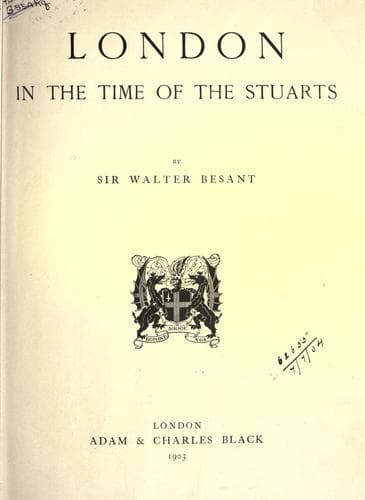
London (England) -- History -- 17th century; London (England) -- Social life and customs -- 17th century
The events of the greatest importance to the City, apart from those
which belong to the whole nation, were the repeated visitations of
Plague, and the Great Fire. The former came and went; it destroyed
the people, chiefly the common people, by thousands; its immediate
effect was a dearth of craftsmen and servants, a rise in wages, and an
improvement in the standard of life in the lower levels. The lessons
which it taught and continually enforced were learned most imperfectly.
They were simple—the admission into the courts and lanes of the crowded
City of light and air; the invention of some system of sanitation
which would replace the old cesspool and the public latrine; and the
introduction of a plentiful supply of water for the washing of the
people, as well as for their drink and for the flooding of the streets.
Somewhere or other—it must be between Dowgate and Mincing Lane—there is
still existing under ground the great Roman Cloaca; it is an additional
proof of the desertion and desolation of the City after the Romans went
away that the Cloaca was forgotten, choked up, and its mouth covered
over; the creation of the foreshore covered it up. Had it been found,
say, in the thirteenth or fourteenth century, the whole modern sanitary
system might have been invented and developed by its means, and so the
Plague would have been stayed. I have attempted to present an adequate
account of the Plague from contemporary evidence. As regards the Fire I
have essayed a restoration of the City before and after that event.
Turning to events political, I have already stated the difficulties
which confront the historian of London in this century. The reader
will not look here for a detailed history of the Civil War or the
Protectorate. I hope, however, that he will find some indication of
the way in which the people of London regarded the events which were
working out their redemption for them, in ways which were unexpected,
by trials which were hard to bear, and after a time when all seemed
lost.
Considering London alone, the Restoration seems to me to have been
a natural, a wholesome, and a most fortunate reaction against the
successive rule of Presbyterian, Independent, and Captain or Colonel.
It must have become quite clear even to men like Milton, who was one
of the last to lift his voice against the return of a king, that a
Commonwealth was too far in advance of the people, and that a military
despotism was intolerable.
In the same way the Revolution was a swing back of the pendulum; it was
quite as natural and as salutary as the rebellion against Charles and
the Restoration of his son. I read this lesson clearly in the history
of London, and I assume it for the history of the country.
Public-domain text, read in full here on John Shaqi.
Reviews
Reviews
No reviews yet
Be the first to share your thoughts on this work.
Join the Discussion
Join the discussion
Sign in to leave a comment or review.
Sign InorCreate an account