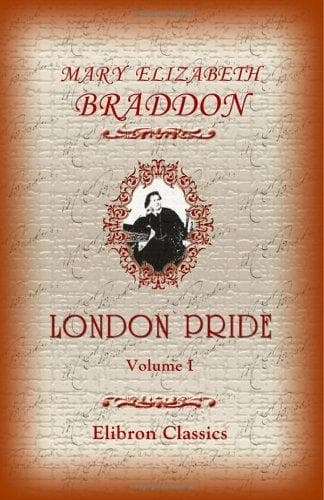
London Pride, Or, When the World Was YoungerBraddon, M. E. (Mary Elizabeth)
History
London Pride, Or, When the World Was Younger
Braddon, M. E. (Mary Elizabeth)
Great Britain -- History -- Charles II, 1660-1685 -- Fiction; London (England) -- Fiction
The face lighted suddenly at this moment, as four great grey Flanders
horses came clattering along the narrow street and into the square,
dragging a heavy painted wooden coach after them. The girl opened the
casement and craned out her neck to look at the arrival The coach
stopped at the convent door, and a footman alighted and rang the
convent bell, to the interested curiosity of two or three loungers upon
the steps of the town hall over the way.
Yes, it was her father, greyer but less sad of visage than at his last
visit. His doublet and cloak were handsomer than the clothes he had
worn then, though they were still of the same fashion, that English
mode which he had affected before the beginning of the troubles, and
which he had never changed.
Immediately after him there alighted a vision of beauty, the loveliest
of ladies, in sky-blue velvet and pale grey fur, and with a long white
feather encircling a sky-blue hat, and a collar of Venetian lace
veiling a bosom that scintillated with jewels.
“Hyacinth!” cried Angela, in a flutter of delight.
The portress peered at the visitors through her spy-hole, and being
satisfied that they were the expected guests, speedily opened the
iron-clamped door.
There was no one to interfere between father and daughter, sister and
sister, in the convent parlour. Angela had her dear people all to
herself, the Mother Superior respecting the confidences and outpourings
of love, which neither father nor children would wish to be witnessed
even by a kinswoman. Thus, by a rare breach of conventual discipline,
Angela was allowed to receive her guests alone.
The lay-sister opened the parlour door and ushered in the visitors, and
Angela ran to meet her father, and fell sobbing upon his breast, her
face hidden against his velvet doublet, her arms clasping his neck.
“What, mistress, hast thou so watery a welcome, now that the clouds
have passed away, and every loyal English heart is joyful?” cried Sir
John, in a voice that was somewhat husky, but with a great show of
gaiety.
“Oh, sir, I have waited so long, so long for this day. Sometimes I
thought it would never come, that I should never see my dear father
again.”
Public-domain text, read in full here on John Shaqi.
Reviews
Reviews
No reviews yet
Be the first to share your thoughts on this work.
Join the Discussion
Join the discussion
Sign in to leave a comment or review.
Sign InorCreate an account