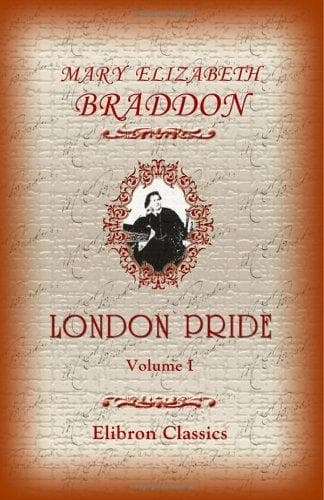
London Pride, Or, When the World Was YoungerBraddon, M. E. (Mary Elizabeth)
History
London Pride, Or, When the World Was Younger
Braddon, M. E. (Mary Elizabeth)
Great Britain -- History -- Charles II, 1660-1685 -- Fiction; London (England) -- Fiction
Angela’s heart beat fast at the thought of being restored to these dear
ones, were it only for a short span. They were not going to carry her
away from the convent; and, indeed, seeing that she so loved her aunt,
the good reverend mother, and that her heart cleaved to those walls and
to the holy exercises which filled so great a part of her life, her
father, in replying to a letter in which she had besought him to
release her from her promise and allow her to dedicate herself to God,
had told her that, although he could not surrender his daughter, to
whom he looked for the comfort of his closing years, he would not urge
her to leave the Ursulines until he should feel himself old and feeble,
and in need of her tender care. Meanwhile she might be a nun in all but
the vows, and a dutiful niece to her kind aunt, Mother Anastasia, whose
advanced years and failing health needed all consideration.
But now, before he went back to England, whither he hoped to accompany
the King and the Princes ere the year was much older, Sir John Kirkland
was coming to visit his younger daughter, bringing Lady Fareham, whose
husband was now in attendance upon His Majesty in Holland, where there
were serious negotiations on hand—negotiations which would have been
full of peril to the English messengers two years ago, when that
excellent preacher and holy man, Dr. Hewer, of St. Gregory, was
beheaded for having intelligence with the King, through the Marquess of
Ormond.
The parlour window jutted into the square over against the town hall,
and Angela could see the whole length of the narrow street along which
her father’s carriage must come.
The tall, slim figure and the fair, girlish face stood out in full
relief against the grey stone mullion, bathed in sunlight. The graceful
form was undisguised by courtly apparel. The soft brown hair fell in
loose ringlets, which were drawn back from the brow by a band of black
ribbon. The girl’s gown was of soft grey woollen stuff, relieved by a
cambric collar covering the shoulders, and by cambric elbow-sleeves. A
coral and silver rosary was her only ornament; but face and form needed
no aid from satins or velvets, Venetian lace or Indian filagree.
The sweet, serious face was chiefly notable for eyes of darkest grey,
under brows that were firmly arched and almost black. The hair was a
dark brown, the complexion somewhat too pale for beauty. Indeed, that
low-toned colouring made some people blind to the fine and regular
modelling of the high-bred face; while there were others who saw no
charm in a countenance which seemed too thoughtful for early youth, and
therefore lacking in one of youth’s chief attractions—gladness.
Public-domain text, read in full here on John Shaqi.
Reviews
Reviews
No reviews yet
Be the first to share your thoughts on this work.
Join the Discussion
Join the discussion
Sign in to leave a comment or review.
Sign InorCreate an account