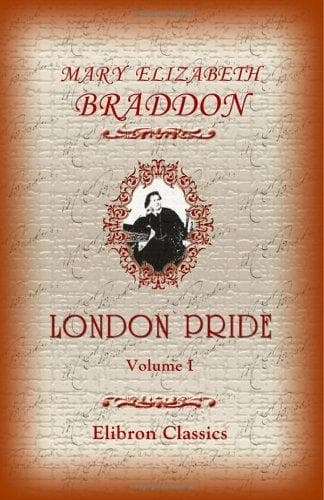
London Pride, Or, When the World Was YoungerBraddon, M. E. (Mary Elizabeth)
History
London Pride, Or, When the World Was Younger
Braddon, M. E. (Mary Elizabeth)
Great Britain -- History -- Charles II, 1660-1685 -- Fiction; London (England) -- Fiction
“What I gave I gave, child. I gave him youth—that never comes back—and
fortune, that is not worth grieving for. And now that I have begun to
lose the reckoning of my years since fifty, I feel I had best take
myself back to that roving life in which I have no time to brood upon
losses and sorrows.”
“Dear father, I am sure you must mistake the King’s feelings towards
you. It is not possible that he can think lightly of such devotion as
yours.”
“Nay, sweetheart, who said he thinks lightly? He never thinks of me at
all, or of anything serious under God’s sky. So long as he has spending
money, and can live in a circle of bright eyes, and hear only flippant
tongues that offer him a curious incense of flattery spiced with
impertinence, Charles Stuart has all of this life that he values. And
for the next—a man who is shrewdly suspected of being a papist, while
he is attached by gravest vows to the Church of England, must needs
hold heaven’s rewards and hell’s torments lightly.”
“But Queen Catherine, sir—does not she favour you? My aunt says she is
a good woman.”
“Yes, a good woman, and the nearest approach to a cypher to be found at
Hampton Court or Whitehall. Young Lord Rochester has written a poem
upon ‘Nothing.’ He might have taken Queen Catherine’s name as a
synonym. She is nothing; she counts for nothing. Her love can benefit
nobody; her hatred, were the poor soul capable of hating persistently,
can do no one harm.”
“And the King—is he so unkind to her?”
“Unkind! No. He allows her to live. Nay, when for a few days—the brief
felicity of her poor life—she seemed on the point of dying, he was
stricken with remorse for all that he had not been to her, and was
kind, and begged her to live for his sake. The polite gentleman meant
it for a compliment—one of those pious falsehoods that men murmur in
dying ears—but she took him at his word and recovered; and she is there
still, a little dark lady in a fine gown, of whom nobody takes any
notice, beyond the emptiest formality of bent knees and backward steps.
There are long evenings at Hampton Court in which she is scarce spoken
to, save when she fawns upon the fortunate lady whom she began by
hating. Oh, child, I should not talk to you of these things; but some
of the disgust that has made my life bitter bubbles over in spite of
me. I am a wanderer and an exile again, dear heart. I would sooner
trail a pike abroad than suffer neglect at home. I will fight under any
flag so long as it flies not for my country’s foe. I am going back to
my old friends at the Louvre, to those few who are old enough to care
for me; and if there come a war with Spain, why my sword may be of some
small use to young Louis, whose mother was always gracious to me in the
old days at St. Germain, when she knew not in the morning whether she
would go safe to bed at night. A golden age of peace has followed that
wild time; but the Spanish king’s death is like to light the torch and
set the war-dogs barking.
Public-domain text, read in full here on John Shaqi.
Reviews
Reviews
No reviews yet
Be the first to share your thoughts on this work.
Join the Discussion
Join the discussion
Sign in to leave a comment or review.
Sign InorCreate an account