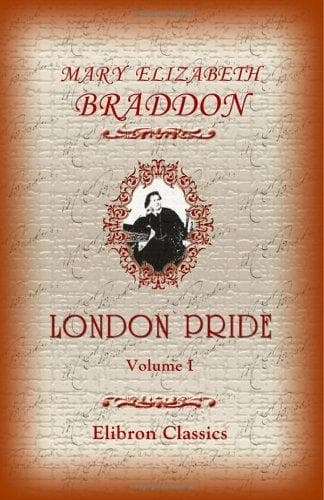
London Pride, Or, When the World Was Younger — John Shaqi
London Pride, Or, When the World Was YoungerBraddon, M. E. (Mary Elizabeth)
History
London Pride, Or, When the World Was Younger
Braddon, M. E. (Mary Elizabeth)
Great Britain -- History -- Charles II, 1660-1685 -- Fiction; London (England) -- Fiction
The boat passed in front of Lord Arundel’s sumptuous mansion, with its
spacious garden, where marble statues showed white in the midst of
quincunxes, and prim hedges of cypress and yew; past the Palace of the
Savoy, with its massive towers, battlemented roof, and double line of
mullioned windows fronting the river; past Worcester House, where Lord
Chancellor Hyde had been living in a sober splendour, while his
princely mansion was building yonder on the Hounslow Road, or that
portion thereof lately known as Piccadilly. That was the ambitious pile
of which Hyacinth had written, a house of clouded memories and briefest
tenure; foredoomed to vanish like a palace seen in a dream; a transient
magnificence, indescribable; known for a little while opprobriously as
Dunkirk House, the supposed result of the Chancellor’s too facile
assistance in the surrender of that last rag of French territory. The
boat passed before Rutland House and Cecil House, some portion of which
had lately been converted into the Middle Exchange, the haunt of fine
ladies and Golconda of gentlewomen milliners, favourite scene for
assignations and intrigues; and so by Durham House, where in the
Protector Seymour’s time the Royal Mint had been established; a house
whose stately rooms were haunted by tragic associations, shadows of
Northumberland’s niece and victim, hapless Jane Grey, and of fated
Raleigh. Here, too, commerce shouldered aristocracy, and the New
Exchange of King James’s time competed with the Middle Exchange of
later date, providing more milliners, perfumers, glovers, barbers, and
toymen, and more opportunity for illicit loves and secret meetings.
Before Angela’s eyes those splendid mansions passed like phantom
pictures. The westering sunlight showed golden above the dark Abbey,
while she sat silent, with awe-stricken gaze, looking out upon this
widespread city that lay chastened and afflicted under the hand of an
angry God. The beautiful, gay, proud, and splendid London of the West,
the new London of Covent Garden, St. James’s Street, and Piccadilly,
whose glories her sister’s pen had depicted with such fond enthusiasm,
was now deserted by the rabble of quality who had peopled its palaces,
while the old London of the East, the historic city, was sitting in
sackcloth and ashes, a place of lamentations, a city where men and
women rose up in the morning hale and healthy, and at night-fall were
carried away in the dead-cart, to be flung into the pit where the dead
lay shroudless and unhonoured.
Public-domain text, read in full here on John Shaqi.
Reviews
Reviews
No reviews yet
Be the first to share your thoughts on this work.
Join the Discussion
Join the discussion
Sign in to leave a comment or review.
Sign InorCreate an account