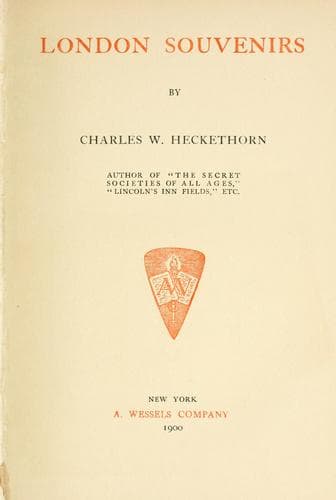
London (England) -- Description and travel; London (England) -- History -- 1800-1950
Some counsel are very fond of reminding a witness at every other
question they put to him that he is ’on his oath.’ The practice is
absurd, the very reminder sounds sarcastic. This ’taking the oath’ is a
relic of ancient barbarism and superstition; for the man who means to
tell the truth it is unnecessary, and on the man who intends to tell a
lie it is no check; he looks on the proceeding as a ridiculous ceremony.
The very official who administers the oath in court, by the way he
rattles it off, shows in what estimation he holds it. Nay, in matters
far more important than the mere stealing of a piece of cheese off a
counter, on occasions when one would expect taking the oath to be
invested with some solemnity, how is it done? I once accompanied an
Italian friend of mine, who was being naturalized in this country, to
the court where he was to take the oath of allegiance. This is how the
official authorized to administer the oath rushed through it: ’I A. B.
do swear that I will be faithful and bear true allegiance to Her Majesty
Queen Victoria her heirs and successors according to law so help me God
it will be half a crown.’ My friend produced the half-crown, which, I
suppose, stood in place of a seal, and the performance was over. With
the court ’So help me God it will be half a crown’ was evidently the
chief point, the crowning glory and confirmation of the allegiance
business.
Swearing children as witnesses leads to very ludicrous scenes, enough to
cover the whole proceeding with contempt, and show its utter futility.
Montagu Williams, Q.C., tells a good story:
At a trial a discussion arose as to whether or no a boy of very tender
age was old enough to be sworn. The judge, at the suggestion of counsel
for the prosecution, interrogated the boy: ’Do you know what will become
of you if you tell an untruth?’
The boy, evidently brought up in the Spurgeon school, replied: ’Hell
fire.’
’What will become of you if you play truant, and do not go to school?’
’Hell fire,’ again answered the boy.
’What if you spill the milk?’
’Hell fire.’
His lordship ran through a list of trifling faults; the punishment was
always the same—’Hell fire.’
Counsel then suggested that the boy was scarcely intelligent enough to
be sworn. But the judge thought otherwise, and expected he would grow
up a very good man, seeing he believed that the most trifling error
involved the penalty of hell fire, and the boy was sworn. The boy, of
course, was a fool, through no fault of his, but through that of his
bigoted teachers.
Public-domain text, read in full here on John Shaqi.
Reviews
Reviews
No reviews yet
Be the first to share your thoughts on this work.
Elsewhere in the archive
Join the Discussion
Join the discussion
Sign in to leave a comment or review.
Sign InorCreate an account