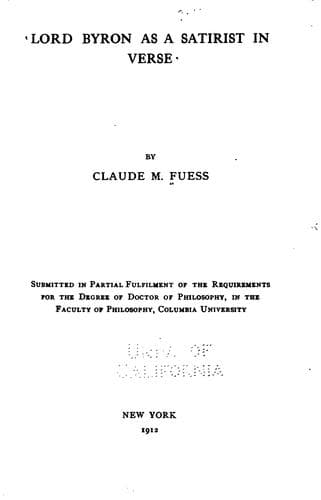
Lord Byron as a satirist in verseFuess, Claude Moore
History
Lord Byron as a satirist in verse
Fuess, Claude Moore
Byron, George Gordon Byron, Baron, 1788-1824 -- Criticism and interpretation; Verse satire, English -- History and criticism
“I think I hear a little bird, who sings
The people by and by will be the stronger.”[293]
Such lines as these show a maturity and an earnestness that mark
the evolution of Byron’s satiric spirit from the hasty petulance of
_English Bards_ to the humanitarian breadth of his thoughtful manhood.
Like “Young Azim” in Moore’s _Veiled Prophet of Khorassan_, he is eager
to march and command under the banner on which is emblazoned “Freedom
to the World.”
It is characteristic of Byron’s later satire that he applied his theory
of liberty to the current problems of British politics by assailing the
obnoxious domestic measures instituted by the Tory ministry of Lord
Liverpool, by condemning the English foreign policy of acquiescence
in the legitimist doctrines of Metternich and the continental powers,
and by attacking the characters of the ministers whom he considered
responsible for England’s position at home and abroad. The England of
the time of _Don Juan_ was the country which Shelley so graphically
pictured in his _Sonnet: England in 1819_:--
“An old, mad, blind, despised, and dying king, ...
Rulers who neither see, nor feel, nor know,
But leech-like to their fainting country cling,
Till they drop, blind in blood, without a blow, ...
A people starved and stabbed in the untilled field.”
It was a nation exhausted by war, burdened with debt, and seething
with discontent. The Luddite outbreaks, the “Manchester Massacre,”
which so excited the wrath of Shelley, and the “Cato Street Conspiracy”
showed the temper of the poor and disaffected classes. Unfortunately
the cabinet saw the solution of these difficulties not in reform
but in repression, and preferred to put down the uprisings by force
rather than to remove their causes. For these conditions Byron blamed
Castlereagh, the Foreign Secretary.
Byron had never met Castlereagh and had never suffered a personal
injury from him; his rage, therefore, was directed solely at the
statesman, not at the man. The Secretary had long been detestable to
Irish Whigs like Moore[294] and English radicals like Shelley[295]; it
remained for Byron to track him through life with venomous hatred and
to pursue him beyond the grave with scathing epigrams. For anything
comparable aimed at a man in high position we must go back to Marvell’s
satires on Charles II and the Duke of York or to the contemporary
satire in 1762 on Lord Bute. Byron’s Castlereagh has no virtues; the
portrait, like Gifford’s sketch of Peter Pindar, is all in dark colors.
The satire is vehement and personal, without malice and without pity.
Public-domain text, read in full here on John Shaqi.
Reviews
Reviews
No reviews yet
Be the first to share your thoughts on this work.
Elsewhere in the archive
Join the Discussion
Join the discussion
Sign in to leave a comment or review.
Sign InorCreate an account