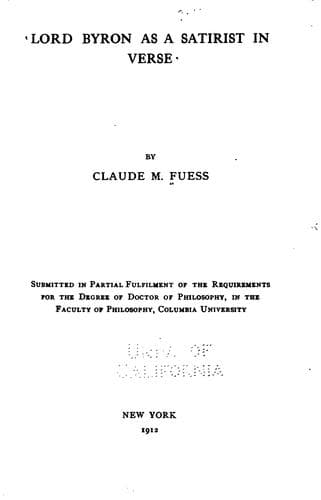
Lord Byron as a satirist in verseFuess, Claude Moore
History
Lord Byron as a satirist in verse
Fuess, Claude Moore
Byron, George Gordon Byron, Baron, 1788-1824 -- Criticism and interpretation; Verse satire, English -- History and criticism
Byron also attacked Wellington, but in manner ironic and scornful, as a
leader who had lost all claim to the gratitude of the people by allying
himself with their oppressors. For George, who as Regent and King, had
done nothing to redeem himself with his subjects, Byron had little but
contempt. In satirizing these men, however, Byron was perhaps less
effective than Moore, over whose imitations of Castlereagh’s orations
and “best-wigged Prince in Christendom,” people smiled when Byron’s
tirades seemed too vicious.
Through the method commonly called dramatic, or indirect, Byron
assailed English politicians in his portrayal of Lord Henry
Amundeville, the statesman who is “always a patriot--and sometimes
a placeman,” and who is representative of the unemotional, just,
yet altogether selfish British minister. The type is drawn with
considerable skill and with much less rancor than would have been
possible with Byron ten years before. Indeed the satire resembles
Dryden’s in that it admits of a wide application and is not limited to
the individual described.
Nothing in Byron’s political creed redounds more to his credit than his
persistent opposition to all war except that carried on in the “defence
of freedom, country, or of laws.” Neglecting the pride and pomp of war,
he depicted the Siege of Ismail with ghastly realism, laying emphasis
on the blood and carnage of the battle and condemning especially
mercenary soldiers, “those butchers in large business.” Though this
attitude towards warfare was not original with him,[296] Byron spoke
out with a firmness and pertinacity that marked him as far ahead of his
age.
Though Byron, in _Don Juan_, was almost entirely a destructive critic
of the political situation in England and in Europe, his ideas were
exceedingly influential. In spite of the fact that he had no definite
remedy to offer for intolerable conditions, his daring championship
of oppressed peoples affected European thought, not only during his
lifetime, but also for years after his death. He was revered in Greece
as more than mortal; he was an inspiration for Mazzini and Cavour;
he seemed to Lamartine an apostle of liberty. It is probably to his
insistence on the rights of the people and to his sweeping indictment
of autocratic rule that he owes the greatest part of his international
recognition.
Public-domain text, read in full here on John Shaqi.
Reviews
Reviews
No reviews yet
Be the first to share your thoughts on this work.
Elsewhere in the archive
Join the Discussion
Join the discussion
Sign in to leave a comment or review.
Sign InorCreate an account