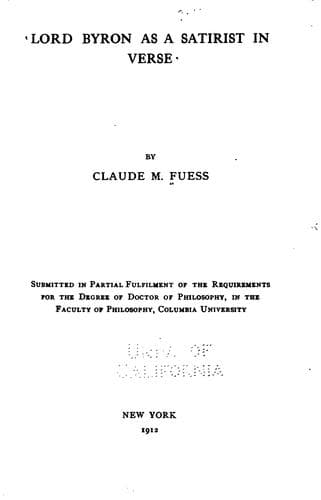
Lord Byron as a satirist in verseFuess, Claude Moore
History
Lord Byron as a satirist in verse
Fuess, Claude Moore
Byron, George Gordon Byron, Baron, 1788-1824 -- Criticism and interpretation; Verse satire, English -- History and criticism
Byron’s iconoclastic tendencies showed themselves also in his attack
on English society, in which he aimed to expose the selfishness,
stupidity, and affectation of the small class that represented the
aristocratic circle of the nation. In dealing with this subject he knew
of what he was speaking, for he had been a member and a close observer
of “that Microcosm on stilts yclept the Great World.” His picture of
this upper class is humorous and ironic, but seldom vehement. In a
series of vivid and often brilliant character sketches he delineates
the personages that Juan, Ambassador of Russia, meets in London,
touching cleverly on their defects and vices, and unveiling the
sensuality, jealousy, and deceit which their outward decorum covers.
Though the figures are types rather than individuals, they were in many
cases suggested by men and women whom Byron knew. Possibly the most
effective satire occurs in the description of the gathering at Lady
Adeline’s country-seat, Norman Abbey, where some thirty-three guests,
“the Brahmins of the Ton,” meet at a fashionable house party.[297]
For these social parasites and office seekers Byron felt nothing but
contempt. His advice to Juan moving among them is:
“Be hypocritical, be cautious, be
Not what you _seem_, but always what you _see_.”[298]
He describes their life as dull and uninteresting, a gay masquerade
which palls when all its delights have been tried. Its prudery conceals
scandal, treachery, and lust; its great vices are hypocrisy and
cant--“cant political, cant religious, cant moral.”[299] Indeed the
satire of _Don Juan_, from Canto XI to the point where the poem is
broken off, is an attack on pretence and sham, and a vindication of the
free and natural man. Byron’s motive may have been, in part, the desire
for revenge on the circle which had cast him out; but certainly he was
disgusted with the narrowness and conventionality of his London life,
and his newly acquired jesting manner found in it a suitable object for
satire.
While Byron’s liberalism and democracy were doing effective service
in pointing out flaws in existing political and social systems, he
was still maintaining, not without many inconsistencies, his old
conservative doctrines in literature, and doggedly insisting on the
virtue of his literary commandments:
“Thou shalt believe in Milton, Dryden, Pope;
Thou shalt not set up Wordsworth, Coleridge, Southey.”[300]
Public-domain text, read in full here on John Shaqi.
Reviews
Reviews
No reviews yet
Be the first to share your thoughts on this work.
Elsewhere in the archive
Join the Discussion
Join the discussion
Sign in to leave a comment or review.
Sign InorCreate an account