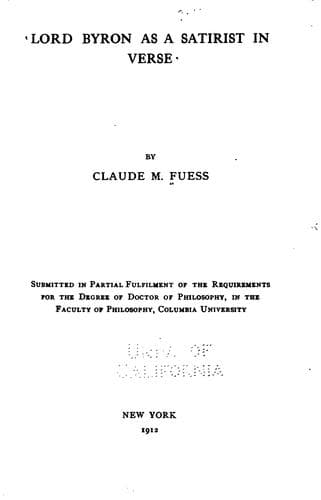
Lord Byron as a satirist in verseFuess, Claude Moore
History
Lord Byron as a satirist in verse
Fuess, Claude Moore
Byron, George Gordon Byron, Baron, 1788-1824 -- Criticism and interpretation; Verse satire, English -- History and criticism
While he was being hailed as a leader of the romantic school of poetry,
he was still defending the principles of Pope, praising the work of
Crabbe, Rogers, and Campbell, and disapproving of the verses of the
members of the Lake School. He dedicated _Don Juan_, in a mocking and
condescending fashion, to Southey, and described him in the sketch of
the bard “paid to satirise or flatter” who sang to Haidée and Juan
the beautiful lyric, _The Isles of Greece_.[301] He ridiculed _The
Waggoner_ and _Peter Bell_, treating Wordsworth with an hostility which
is almost inexplicable in view of Byron’s indebtedness in _Childe
Harold_, III and IV to the older poet’s feeling for nature. Only in
minor respects had Byron’s position changed; he was more appreciative
of Scott and less vindictive towards Jeffrey; and he had found at least
one new literary enemy in the poetaster, William Sotheby. In general
there was little for him to add to what he had already said in _English
Bards_. His otherwise progressive spirit had not extended into the
field of literary criticism.
It is not at all surprising that a large portion of _Don Juan_ should
be devoted to two subjects in which Byron had always been deeply
interested--woman and love. Nor is it at all remarkable, in view of his
singularly complex and variable nature, that the poem should contain
not only the exquisite idyll of Haidée but also line after line of
cynical satire on her sex. Though Byron’s opinion of women was usually
not complimentary, sentiment, and even sentimentality of a certain
sort, had a powerful attraction for him. If many of his love affairs
were followed and even accompanied by cynicism, it was because the
passion in such cases was sensual, and in reaction, he went to the
other extreme. The influence of the Guiccioli, however, manifest in
his descriptions of Haidée and Aurora Raby, was beneficial to Byron’s
character, and his ideas of love were somewhat altered through his
relations with her. At the same time the conventional assertions of
woman’s inconstancy and treachery so common in his earlier work recur
frequently in _Don Juan_.
Love, according to Byron’s philosophy, can exist only when it is free
and untrammelled. The poet’s too numerous amours and the general laxity
of Italian morals had joined in exciting in him a prejudice against
English puritanism; while his own unfortunate marital experience had
convinced him that “Love and Marriage rarely can combine.”[302] The
remembrance of his married life and his observation in the land of his
adoption were both instrumental in forming his conclusion:
“There’s doubtless something in domestic doings,
Which forms, in fact, true love’s antithesis.”[303]
When marriage, then, is so unalluring, the logical refuge is an
honest friendship with a married lady, “of all connections the most
steady.”[304] When Byron does speak of women with apparent respect, it
is always well to search for irony behind. If he says, evidently with
emotion:
Public-domain text, read in full here on John Shaqi.
Reviews
Reviews
No reviews yet
Be the first to share your thoughts on this work.
Elsewhere in the archive
Join the Discussion
Join the discussion
Sign in to leave a comment or review.
Sign InorCreate an account