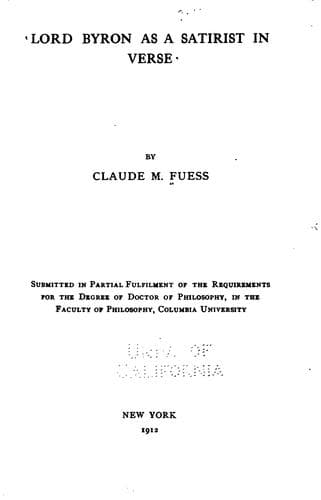
Lord Byron as a satirist in verseFuess, Claude Moore
History
Lord Byron as a satirist in verse
Fuess, Claude Moore
Byron, George Gordon Byron, Baron, 1788-1824 -- Criticism and interpretation; Verse satire, English -- History and criticism
“All who have loved, or love, will still allow
Life has nought like it. God is love, they say,
And love’s a god,”[305]
he qualifies his ecstacy elsewhere by asserting that Love is “the very
God of evil.”[306] Although he protests that he loves the sex,[307]
he must add that they are deceitful,[308] hypocritical,[309] and
fickle.[310]
Nothing in the first two cantos of _Don Juan_ was more offensive to
Hobhouse and the “Utican Senate” to which Murray submitted them than
the poorly disguised portrayal of Lady Byron in the character of Donna
Inez. Though Byron explicitly disavowed all intention of satirising
his wife directly, no one familiar with the facts could possibly have
doubted that this lady “whose favorite science was the mathematical,”
who opened her husband’s trunks and letters, and tried to prove her
loving lord mad, and who acted under all circumstances like “Morality’s
prim personification” was intended to represent the former Miss
Milbanke and present Lady Byron.
Doubtless there is something artificial and affected in much of Byron’s
cynical comment on women and love; but if we are inclined to distrust
this man of many amours who delights in flaunting his past before
the eyes of his shocked compatriots, we must remember that there is
probably no conscious insincerity in his words. Byron frequently
deludes not only his readers but himself, and his satire on women, when
it is not a kind of bravado, is merely part of his worldly philosophy.
The philosophical conceptions on which _Don Juan_ rests are, in their
general trend, not uncommonly satirical; that is, they are destructive
rather than constructive, skeptical rather than idealistic, founded on
doubt rather than on faith. It is the object of the poem to overturn
tottering institutions, to upset traditions, and to unveil illusions.
Byron’s attitude is that so often taken by a thorough man of the world
who has tasted pleasure to the point of satiety, and who has arrived
at early middle age with his enthusiasms weakened and his faith sunk
in pessimism. This accounts for much of the realism in the poem.
Sometimes the poet, in the effort to portray things as they are, merely
transcribes the prose narratives of others into verse,[311] just as
Shakspere borrowed passages from North’s _Plutarch_ for _Julius Cæsar_.
More often he undertakes to detect and reveal the incongruity between
actuality and pretence, and to expose weakness and folly under its mask
of sham. The realism of this sort closely resembles the more modern
work of Zola, attributing as it does even good actions to low motives
and degrading deliberately the better impulses of mankind. In Byron’s
case it seems to be the result partly of a wish to avoid carrying
sentiment and romance to excess, partly of a distorted or partial view
of life. Whatever romance there is in _Don Juan_--and the amount is
not inconsiderable--is invariably followed by a drop into bathos or
absurdity.
Public-domain text, read in full here on John Shaqi.
Reviews
Reviews
No reviews yet
Be the first to share your thoughts on this work.
Elsewhere in the archive
Join the Discussion
Join the discussion
Sign in to leave a comment or review.
Sign InorCreate an account