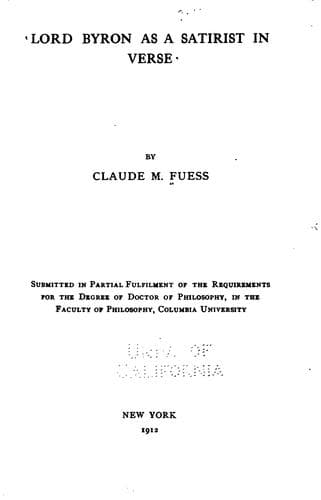
Lord Byron as a satirist in verseFuess, Claude Moore
History
Lord Byron as a satirist in verse
Fuess, Claude Moore
Byron, George Gordon Byron, Baron, 1788-1824 -- Criticism and interpretation; Verse satire, English -- History and criticism
The deservedly famous “Ave Maria,”[312] with its exquisite
sentiment and melody, is closed by a stanza harsh and grating, which
calls the reader with a shock back to a lower level. This juxtaposition
of tenderness and mockery, tending by contrast to accentuate both
moods, is highly characteristic of the spirit of the poem. Juan’s
lament for Donna Julia is interrupted by sea-sickness,[313] and his
rhetorical address on London, “Freedom’s chosen station,” is broken off
by “Damn your eyes! your money or your life.”[314] Byron never overdoes
the emotional element in _Don Juan_; he draws us back continually to
the commonplace, and sometimes to the mean and vulgar.[315]
Byron’s materialistic and skeptical habit of mind is often put into
phraseology that recalls the “Que sais-je?” of Montaigne. Rhetorical
disquisitions on the vanity of human knowledge and of worldly
achievement had appeared in _Childe Harold_[316]; in _Don Juan_ the
poet dismisses the great problems of existence with a jest:
“What is soul, or mind, their birth and growth,
Is more than I know--the deuce take them both.”[317]
In the words of the British soldier, Johnson, to Juan, we have,
perhaps, a summary of the position which Byron himself had reached:
“There are still many rainbows in your sky,
But mine have vanished. All, when Life is new,
Commence with feelings warm and prospects high;
But Time strips our illusions of their hue,
And one by one in turn, some grand mistake
Casts off its bright skin yearly like the snake.”[318]
As a corollary to this recognition of the futility of human endeavor,
the doctrine of mutability, so common in Shelley’s poetry, appears
frequently in _Don Juan_,[319] ringing in the note of sadness which
Byron would have us believe was his underlying mood. Curiously enough,
though he cynically classed together “rum and true religion” as calming
to the spirit,[320] he was chary of assailing Christian theology or
orthodox creeds. He preserved a kind of respect for the Church; and
even Dr. Kennedy was obliged to admit that on religious questions Byron
was a courteous and fair, as well as an acute, antagonist. Perhaps
the half-faith which led him to say once “The trouble is I do believe”
may account for the fact that, at a time when William Hone and other
satirists were making the Church of England a target for their wit,
_Don Juan_ contained no reference to that institution.
Byron, then, refused to accept any of the creeds and idealisms of his
day. His own position, however, was marked by doubt and vacillation,
and he took no positive attitude towards any of the great problems
of existence. Experience led him to nothing but uncertainty and
indecision, with the result that he became content to destroy, since he
was unable to construct.
Public-domain text, read in full here on John Shaqi.
Reviews
Reviews
No reviews yet
Be the first to share your thoughts on this work.
Elsewhere in the archive
Join the Discussion
Join the discussion
Sign in to leave a comment or review.
Sign InorCreate an account