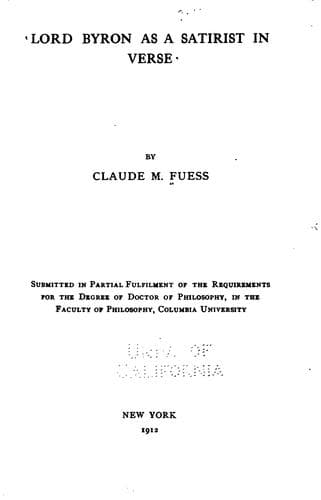
Lord Byron as a satirist in verseFuess, Claude Moore
History
Lord Byron as a satirist in verse
Fuess, Claude Moore
Byron, George Gordon Byron, Baron, 1788-1824 -- Criticism and interpretation; Verse satire, English -- History and criticism
This is no place for discussing the fundamental morality or immorality
of _Don Juan_. The British public of Byron’s day, basing their judgment
largely upon the voluptuousness of certain love scenes and upon some
coarse phrases scattered here and there through the poem, charged him
with “brutally outraging all the best feeling of humanity.” There can
be no doubt that Byron did ignore the ordinary standards of conduct
among average people; though he asserted “My object is Morality,”[321]
no one knew better than he that he was constantly running counter to
the conventional code of behavior. Nor can any one doubt, after a study
of his letters to Murray and Moore, that he felt a sardonic glee in
acting as an agent of disillusion and pretending to be a very dangerous
fellow. This spirit led him to employ profanity in _Don Juan_ until his
friend Hobhouse protested: “Don’t swear again--the third ‘damn.’”[322]
By assailing many things that his time held sacred, by calling love
“selfish in its beginning as its end,”[323] and maintaining that the
desire for money is “the only sort of pleasure that requites,”[324]
Byron drew upon himself the charge of immorality. The poem, however,
does not attempt to justify debauchery or to defend vicious practices;
Byron is attacking not virtue, but false sentiment, false idealism, and
false faith. His satiric spirit is engaged in analyzing and exposing
the strange contradictions and contrasts in human life, in tearing down
what is sham and pretence and fraud. Judged from this standpoint, _Don
Juan_ is profoundly moral.
Fortunately, in this poem the design of which was to exploit the
doctrine of personal freedom, Byron had discovered a medium through
which he could make his individuality effective, in which he could
speak in the first person, leave off his story when he chose, digress
and comment on current events, and voice his every mood and whim. The
colloquial tone of the poem strikes the reader at once. He censures
himself in a jocular way for letting the tale slip forever through his
fingers, and confesses with mock humility,
“If I have any fault, it is digression.”[325]
Public-domain text, read in full here on John Shaqi.
Reviews
Reviews
No reviews yet
Be the first to share your thoughts on this work.
Elsewhere in the archive
Join the Discussion
Join the discussion
Sign in to leave a comment or review.
Sign InorCreate an account