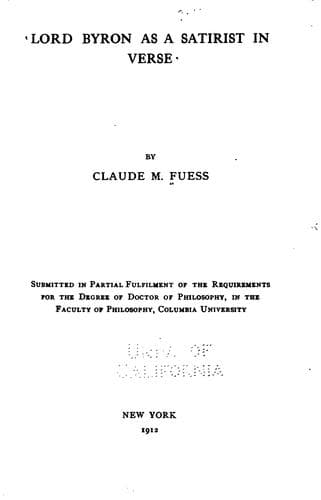
Lord Byron as a satirist in verseFuess, Claude Moore
History
Lord Byron as a satirist in verse
Fuess, Claude Moore
Byron, George Gordon Byron, Baron, 1788-1824 -- Criticism and interpretation; Verse satire, English -- History and criticism
The habit of calling himself back to the narrative becomes almost
as much of an idiosyncrasy as Mr. Kipling’s “But that is another
story.”[326] Obviously Byron’s words are really no more than
half-apologetic; he knew perfectly well what he was doing and why
he was doing it. Without insisting too much on the value of a
mathematical estimate it is still safe to say that _Don Juan_ is fully
half-concerned with that sort of gossipy chat with which Byron’s
visitors at Venice or Pisa were entertained,[327] and as the poem
lengthened, his tendency was to neglect the plot more and more.
Indeed the justification for treating _Don Juan_ as a satire lies
mainly in these side-remarks in which Byron discloses his thoughts
and opinions with so little reserve. The digressions in the poem
are used principally for two purposes: to satirize directly people,
institutions, or theories; to gossip about the writer himself. In
either case we may imagine Byron as a monologist, telling us what he
has done and what he is going to do, what he has seen and heard, what
he thinks on current topics, and illustrating points here and there by
a short anecdote or a compact maxim. In such a series of observations,
extending as they do over a number of years and written as they were
under rapidly shifting conditions, it is uncritical to demand unity. We
might as well expect to find a model drama in a diary. The important
fact is that we have in these digressions a continuous exposition of
Byron’s satire during the most important years of his life.
The peculiar features of the octave stanza, with its opportunity for
double and triple rhymes and the loose structure of its sestette,
made it more suited to Byron’s genius than the more compact and less
flexible heroic couplet. At the same time the concluding couplet of the
octave offered him a chance for brief and epigrammatic expression. In
general it may be said that no metrical form lends itself more readily
to the colloquial style which Byron preferred than does the octave.
In utilizing this stanza, Byron, accepting the methods of Pulci
and Casti, allowed himself the utmost liberties in rhyming and
verse-structure. We have already seen that in several youthful poems,
and, indeed, in some later ephemeral verses, he had shown a fondness
for remarkable rhymes. By the date of _Beppo_ he had broken away
entirely from the rigidity of the Popean theory of poetry, and had
confessed that he enjoyed a freer style of writing:
“I--take for rhyme, to hook my rambling verse on,
The first that Walker’s lexicon unravels,
And when I can’t find that, I put a worse on,
Not caring as I ought for critics’ cavils.”[328]
Public-domain text, read in full here on John Shaqi.
Reviews
Reviews
No reviews yet
Be the first to share your thoughts on this work.
Elsewhere in the archive
Join the Discussion
Join the discussion
Sign in to leave a comment or review.
Sign InorCreate an account