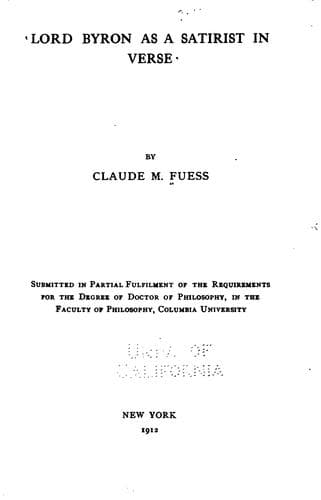
Lord Byron as a satirist in verseFuess, Claude Moore
History
Lord Byron as a satirist in verse
Fuess, Claude Moore
Byron, George Gordon Byron, Baron, 1788-1824 -- Criticism and interpretation; Verse satire, English -- History and criticism
In _Don Juan_ this employment of uncommon rhymes had become a genuine
art. Byron once declared to Trelawney that Swift was the greatest
master of rhyming in English; but Byron is as superior to Swift as
the latter is to Barham and Browning in this respect. Indeed Byron’s
only rival is Butler, and there are many who would maintain, on
good grounds, that Byron as a master of rhyming is greater than the
author of _Hudibras_. When we consider the length of _Don Juan_, the
constant demand for double and triple rhymes, and the fact that Byron
seldom repeated himself, we cannot help marvelling at the linguistic
cleverness which enabled him to discover such unheard-of combinations
of syllables and words. Some of the most extraordinary have become
almost classic,[329] _e.g._:--
“But--Oh! ye lords of ladies intellectual,
Inform us truly, have they not hen-pecked you all?”[330]
“Since in a way that’s rather of the oddest, he
Became divested of his native modesty.”[331]
Naturally in securing such a variety of rhymes he was forced to draw
from many sources. Foreign languages proved a rich field, and he
obtained from them some striking examples of words similar in sound,
sometimes rhyming them with words from the same language, sometimes
fitting them to English words and phrases. Some typical specimens are
worthy of quotation:
Latin--in medias res, please, ease.[332]
Greek--critic is, poietikes.[333]
French--seat, tête-à-tête, bete.[334]
Italian--plenty, twenty, “mi vien in mente.”[335]
Spanish--Lopé, copy.[336]
Russian--Strokenoff, Chokenoff, poke enough.[337]
Byron also resorts to the uses of proper names, borrowed from many
tongues:
Dante’s--Cervantes.[338]
Hovel is--Mephistophelis.[339]
Tyrian--Presbyterian.[340]
Avail us--Sardanapalus.[341]
Pukes in--Euxine.[342]
It may be added, too, that he was seldom over-accurate or
careful in making his rhymes exact. In one instance he rhymes
certainty--philosophy--progeny.[343] Most stanzas have either double or
triple rhymes, but there are occasional stanzas in which all the rhymes
are single.[344]
In _Don Juan_ run-on lines are the rule rather than the exception.
Certain stanzas are really sentences in which the thought moves
straight on, disregarding entirely the ordinary restrictions of
versification.[345] In more than one case the idea is even carried
from one stanza to another without a pause.[346] In one extraordinary
instance a word is broken at the end of a line and finished at
the beginning of the next,[347] following the example set by the
Anti-Jacobin in Rogero’s song in _The Rovers_. Like a public speaker,
Byron at times neglects coherence in order to keep the thread of his
discourse or to digress momentarily without losing grip on his audience.
Public-domain text, read in full here on John Shaqi.
Reviews
Reviews
No reviews yet
Be the first to share your thoughts on this work.
Elsewhere in the archive
Join the Discussion
Join the discussion
Sign in to leave a comment or review.
Sign InorCreate an account