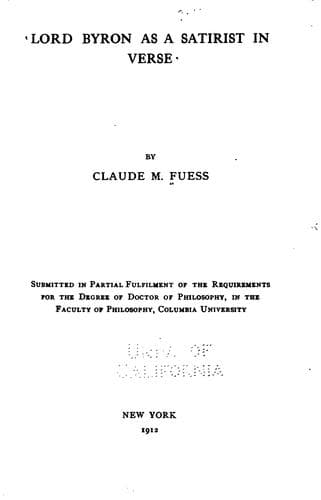
Lord Byron as a satirist in verseFuess, Claude Moore
History
Lord Byron as a satirist in verse
Fuess, Claude Moore
Byron, George Gordon Byron, Baron, 1788-1824 -- Criticism and interpretation; Verse satire, English -- History and criticism
Much of the humor of _Don Juan_ is due to the varied employment of
many forms of verbal wit: puns, plays upon words, and odd repetitions
and turns of expression. The puns are not always commendable for
their brilliance, though they serve often to burlesque a serious
subject. In at least one stanza Byron uses a foreign language in
punning.[348] In general it is noticeable that puns become more common
in the later cantos of the poem.[349] There are also many curious
turns of expression, comparable only to some of the quips of Hood and
Praed.[350] Frequently, they are exceedingly clever in the suddenness
with which they shift the thought and give the reader an unexpected
surprise, _e.g._:
“Lambo presented, and one instant more
Had stopped this canto and Don Juan’s breath.”[351]
Repetitions of words or sounds often convey the effect of a pun, _e.g._:
“They either missed, or they were never missed,
And added greatly to the missing list.”[352]
The witty line,
“But Tom’s no more--and so no more of Tom,”[353]
is an excellent example of Byron’s verbal artistry.
It should be added here, also, that Byron displayed a singular capacity
for coining maxims and compressing much worldly wisdom into a compact
form. Some of his sayings have so far passed into common speech that
they are almost platitudes, _e.g._:
“There is no sterner moralist than pleasure.”[354]
As has been pointed out, this kind of sententious utterance in the form
of a proverb or an epigram was very common with the Italian burlesque
writers, especially with Pulci.
Something of the universality of Don Juan, of its appeal, not only to
particular countries and peoples, but also to the world at large, may
be indicated by the number of translations of it which exist.[355] It
appeared in French in 1827, in Spanish in 1829, in Swedish in 1838, in
German in 1839, in Russian in 1846, in Roumanian in 1847, in Italian
in 1853, in Danish in 1854, in Polish in 1863, and in Servian in 1888.
Since these first versions appeared, other and more satisfactory ones
have been published in most of the countries named. It was chiefly
through _Don Juan_ that Byron became, what Saintsbury calls him, “the
sole master of young Russia, young Italy, young Spain, in poetry.” In
these days when Byron’s defence of the rights of the people is less
necessary, when his opposition to despotism would find few tyrants
to oppose, and when his condemnation of war has developed into a
widespread movement for universal peace, the powerful impetus which his
satire gave to the progress of democracy is likely to be overlooked.
His attitude of defiance furnished an illustrious example to struggling
nations, and gave them hope of better things.[356]
Public-domain text, read in full here on John Shaqi.
Reviews
Reviews
No reviews yet
Be the first to share your thoughts on this work.
Elsewhere in the archive
Join the Discussion
Join the discussion
Sign in to leave a comment or review.
Sign InorCreate an account