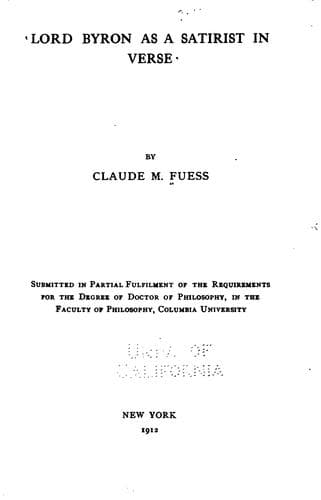
Lord Byron as a satirist in verseFuess, Claude Moore
History
Lord Byron as a satirist in verse
Fuess, Claude Moore
Byron, George Gordon Byron, Baron, 1788-1824 -- Criticism and interpretation; Verse satire, English -- History and criticism
[27] In his _Letters_, Byron refers once to Churchill’s _Times_
(_Letters_, ii., 148). His _Churchill’s Grave_ (1816), a parody of
Wordsworth’s style, contains a reference to Churchill as “him who
blazed the comet of a season.” Otherwise Churchill’s actual influence
on Byron was not great.
[28] Byron praised Crabbe in _English Bards_ as “Nature’s sternest
painter, but her best.” In a letter to Moore, February 2, 1818, he
termed Crabbe and Rogers “the fathers of present Poesy,” and in his
_Reply to Blackwood’s_ (1819) he said publicly: “We are all wrong
except Crabbe, Rogers, and Campbell.” Crabbe, whom Horace Smith called
“Pope in worsted stockings,” seemed, to Byron, to represent devotion to
Pope.
[29] Byron said of Gifford in 1824: “I have always considered him as
my literary father, and myself as his ‘prodigal son’” (_Letters_, vi.,
329).
[30] The movement represented by this clique, _Gli Oziosi_, originated
in Florence with a coterie of dilettanti, among whom were Robert Merry
(1755–1799), Mrs. Piozzi (1741–1831), Bertie Greathead (1759–1826),
and William Parsons (fl. 1785–1807). They published two small volumes,
_The Arno Miscellany_ (1784) and _The Florence Miscellany_ (1785), both
marred by affectation, obscurity, tawdry ornamentation, and frantic
efforts at sublimity. The printing of Merry’s _Adieu and Recall to
Love_ started a new series of sentimental verses, in the writing of
which other scribblers took part: Hannah Cowley (1743–1809), Perdita
Robinson (1752–1800), and Thomas Vaughan (fl. 1772–1820). Their
combined contributions were gathered in Bell’s _British Album_ (1789).
[31] Merry had written a _Wreath of Liberty_ (1790) in praise of
revolutionary principles.
[32] Scott said of Gifford: “He squashed at one blow a set of humbugs
who might have humbugged the world long enough.” _New Morality_ has
a reference to “the hand which brushed a swarm of fools away.” Byron
inserted a similar passage in _English Bards_, 741–744.
[33] _Letters_, iv., 485.
[34] _English Bards_, 701.
[35] Moore speaks sarcastically of this custom in the Preface to
_Corruption and Intolerance_ (1808): “The practice which has been
lately introduced into literature, of writing very long notes upon
very indifferent verses, appears to me a very happy invention, as it
supplies us with a mode of turning dull poetry to account.”
[36] Byron said of the _Pursuits of Literature_: “It is notoriously, as
far as the poetry goes, the worst written of its kind; the World has
long been of but one opinion, viz., that it’s [sic] sole merit lies in
the notes, which are indisputably excellent” (_Letters_, ii., 4).
[37] Examples are the _Fables of Æsop_ (1692) of Roger L’Estrange
(1616–1704); _Æsop at Court, or Select Fables_ (1702) by Thomas Yalden
(1671–1736); _Æsop’s Fables_ (1722) by Samuel Croxall (1680–1752);
_Fables_ (1744) by Edward Moore (1711–1757); and collections by
Nathaniel Cotton (1707–1788) and William Wilkie (1721–1772).
Public-domain text, read in full here on John Shaqi.
Reviews
Reviews
No reviews yet
Be the first to share your thoughts on this work.
Elsewhere in the archive
Join the Discussion
Join the discussion
Sign in to leave a comment or review.
Sign InorCreate an account