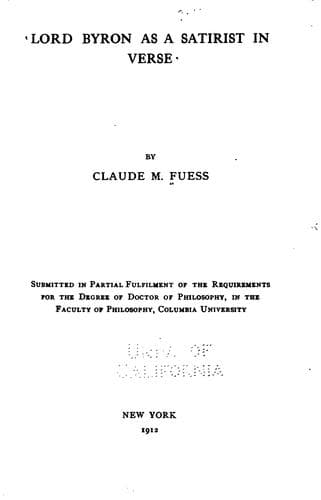
Lord Byron as a satirist in verseFuess, Claude Moore
History
Lord Byron as a satirist in verse
Fuess, Claude Moore
Byron, George Gordon Byron, Baron, 1788-1824 -- Criticism and interpretation; Verse satire, English -- History and criticism
[51] Examples are _Elijah’s Mantle_ (1807) by James Sayer (1748–1823),
with its answer, the anonymous _Elijah’s Mantle Parodied_ (1807); the
_Uti Possidetis and Status Quo_ (1807), _The Devil and the Patriot_
(1807), and Canning’s famous ballad _The Pilot that Weathered the
Storm_.
[52] _Poetry_, i., 17.
[53] _Letters_, i., 209.
[54] It is probable that Byron’s verses are modelled somewhat on the
_Epistle on His Schoolfellows at Eton_ (1766) by his relative and
guardian, Lord Carlisle (1748–1825).
[55] _Letters_, i., 47.
[56] _Letters_, i., 183.
[57] _Letters_, i., 167.
[58] _Letters_, i., 211.
[59] _Letters_, i., 212.
[60] _Blackwood’s_, ix., 461.
[61] This practice was ridiculed by his enemy, Lady Montagu, in the
lines:
“On the one side we see how Horace thought,
And on the other how he never wrote.”
[62] The opening couplet of _English Bards_ is a paraphrase of the
first two lines of Juvenal, I. Other imitations occur in lines 87–88
(Juvenal, I., 17–18) and lines 93–94 (Juvenal, I., 19–21).
[63] _English Bards_, 47–48.
[64] _Satires_, iii., 15–18.
[65] _London_, 35–36.
[66] _Table Talk_, 571–572.
[67] _Baviad_, 215 ff.
[68] _All the Talents_, ii., 46–47.
[69] _English Bards_, 103–106.
[70] _Dunciad_, i., 28.
[71] _Satires_, i., 35–36.
[72] _English Bards_, 819–820.
[73] _English Bards_, 991–994.
[74] See _English Bards_, 144–145, 165–166, 202, 235, etc.
[75] Prologue to the second part of the _Conquest of Granada_, 1–2.
[76] _Essay on Criticism_, 610–630.
[77] _The Apology_ was written in response to a scathing article on
the _Rosciad_, printed in the _Critical Review_ for March, 1761. This
periodical, ultra-Tory in its principles, made a point of decrying, any
work which was by a Whig author, or expressed any sympathy with liberal
ideas. Though the editor, Tobias Smollett, was able to exculpate
himself from the charge, Churchill deemed him accountable for the
uncomplimentary review and, without naming him, described him in his
satire as “alien from God, and foe to all mankind.”
[78] _The Apology_, 110–111.
[79] _English Bards_, 429.
[80] _The Apology_, 44.
[81] _English Bards_, 71.
[82] _Gentle Alterative._
[83] _Baviad_, 200–201.
[84] It is curious that Byron’s views on poetry were not very different
from those held by Jeffrey. Both men believed in maintaining the
common-sense traditions of the eighteenth century.
[85] “There can be no worse sign for the taste of the times than the
depreciation of Pope” (_Letters_, v, 559).
[86] W. Tooke, in his edition of Churchill’s _Works_ (1804), expresses
one phase of contemporary opinion in speaking of “the simplicity of a
later school of poetry, the spawn of the lakes, consisting of a mawkish
combination of the nonsense verse of the nursery with the rhodomontade
of German Mysticism and Transcendentalism” (i., 189).
[87] _Epistles to Pope_, ii., 165.
Public-domain text, read in full here on John Shaqi.
Reviews
Reviews
No reviews yet
Be the first to share your thoughts on this work.
Elsewhere in the archive
Join the Discussion
Join the discussion
Sign in to leave a comment or review.
Sign InorCreate an account