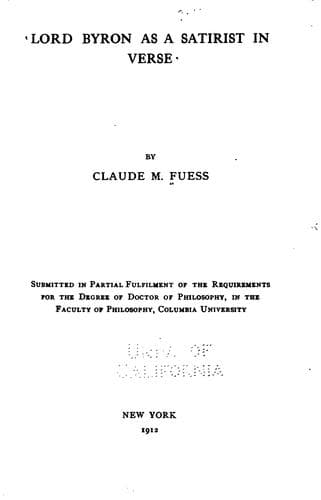
Lord Byron as a satirist in verseFuess, Claude Moore
History
Lord Byron as a satirist in verse
Fuess, Claude Moore
Byron, George Gordon Byron, Baron, 1788-1824 -- Criticism and interpretation; Verse satire, English -- History and criticism
[88] To this utterly unjust stricture Scott made a calm reply in his
Preface to _Marmion_ (1830): “I never could conceive how an arrangement
between an author and his publishers, if satisfactory to the persons
concerned, could afford matter of censure to any third party.”
Certainly Byron came to be a gross offender in this respect himself,
and when, in 1819, he was haggling with Murray over the price of _Don
Juan_, these boyish censures, if they met his eye, must have roused a
smile.
[89] “The plot is absurd, and the antique costume of the language is
disgusting, because it is unnatural” (_All the Talents_, page 68).
[90] _Pursuits of Literature_, iv., 397–398.
[91]
“Then still might Southey sing his crazy Joan,
To feign a Welshman o’er the Atlantic flown,
Or tell of Thalaba the wondrous matter,
Or with clown Wordsworth, chatter, chatter, chatter.”
(_Epics of the Ton_, 31–34.)
[92] After some praise of the three poets, the dedication of the
_Simpliciad_ closes with the words: “I lament the degradation of your
genius, and deprecate the propagation of your perverted taste.”
[93] Pope, in the _Dunciad_, had bantered Sir Richard Blackmore, author
of epics, in the lines:--
“All hail him victor in both gifts of song,
Who sings so loudly, and who sings so long.”
(_Dunciad_, ii., 267–268.)
The possibility that Byron may have had this passage in mind is
increased by his note to his lines in _English Bards_: “Must he
[Southey] be content to rival Sir Richard Blackmore in the quantity as
well as the quality of his verse?”
[94] _Simpliciad_, 212–213.
[95] It must be remembered, however, that practically every charge
that Byron brings against the “Lakists” has a counterpart in Mant’s
_Simpliciad_, printed only a year before Byron’s poem.
[96] _Baviad_, 248–261.
[97] _Letters_, v., 590.
[98] _Letters_, v., 539.
[99] _Letters_, i., 104.
[100] Mathias had asserted that Moore “had neither scrupled nor
blushed to depict, and to publish to the world, the arts of systematic
seduction, and to thrust upon the nation the most open and unqualified
blasphemy against the very code and volume of our religion” (_Pursuits
of Literature_, Preface to Dialogue IV.).
[101] Preface to _Mæviad_, page 59, Note.
[102] See the account of this period in Thorndike’s _Tragedy_, chapter
x.
[103] Byron may have taken a suggestion from some lines of _Children of
Apollo_:
“But in his diction Reynolds grossly errs;
For whether the love hero smiles or mourns,
’Tis oh! and ah! and oh! by turns.”
[104] _Satires_, iii., 197.
[105] _Dunciad_, iv., 45–70.
[106] _Rosciad_, 723–728.
[107] _The Man of Taste._
[108] One line of Byron’s attack,
“Himself a living libel on mankind,”
recalls Murphy’s address to Churchill,
“Thy look’s a libel on the human race.”
Public-domain text, read in full here on John Shaqi.
Reviews
Reviews
No reviews yet
Be the first to share your thoughts on this work.
Elsewhere in the archive
Join the Discussion
Join the discussion
Sign in to leave a comment or review.
Sign InorCreate an account