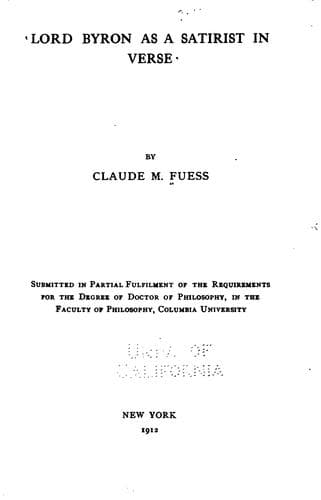
Lord Byron as a satirist in verseFuess, Claude Moore
History
Lord Byron as a satirist in verse
Fuess, Claude Moore
Byron, George Gordon Byron, Baron, 1788-1824 -- Criticism and interpretation; Verse satire, English -- History and criticism
[109] In the _Scourge_, a new venture of Clarke’s begun in 1810, that
editor published another scurrilous attack on Byron, involving also the
poet’s mother. An action for libel which Byron intended to bring was
for some reason abandoned, though not without some caustic words from
him about “the cowardly calumniator of an absent man and a defenceless
woman” (_Letters_, i., 324).
[110] _Letters_, i., 314. See also _Letters_, ii., 312; iii., 192.
[111] _Letters_, ii., 326.
[112] _Letters_, v., 539.
[113] _English Bards_, 209–210; 231–232; 239–240; 253–254; 909–910.
[114] _Ibid._, 415–417; 684–686.
[115] _Ibid._, 417, 1022.
[116] _Ibid._, 608–609; 624–625; 656–657.
[117] _Letters_, ii., 27.
[118] _Recollections of Lord Byron_, page 31.
[119] _Letters_, iv., 488.
[120] See _Pope and the Art of Satire_, by G. K. Chesterton.
[121] _Corruption_, 93–98.
[122] _English Bards_, 841–848.
[123] _Poetry_, i., 291.
[124] _Letters_, ii., 330.
[125] _Letters_, ii., 24.
[126] _Letters_, iv., 425.
[127] _Letters_, v., 221.
[128] _Letters_, v., 245.
[129] _Letters_, v., 255.
[130] _Letters_, v., 77.
[131] There have been many actual translations of the _Ars Poetica_
into English. T. Drant published, in 1567, the first complete
version. Queen Elizabeth left a fragmentary version of 194 lines in
her _Englishings_ (1598). Ben Jonson’s excellent _Horace, of the Art
of Poetry_ was printed after his death. Of other translations, from
that of Roscommon (1680) in blank verse, to that of Howes (1809) in
heroic couplets, it is unnecessary to speak, except to say that they
mount into the hundreds. In such works as _The Art of Preaching_ by
Christopher Pitt (1699–1748) and _The Art of Politicks_ (1731) by
James Bramston (1694–1744) the title and method of Horace had been
transferred to other fields. _Harlequin-Horace; or the Art of Modern
Poetry_ by James Miller (1706–1744) is an ironical parody of the _Ars
Poetica_.
[132] See his treatise, _Ueber das Verhaltnis von Byrons Hints from
Horace zu Horaz und Pope_.
[133] See his article in _Anglia_, ii., 256.
[134] _Ars Poetica_, 269–270.
[135] _Essay on Criticism_, 124–125.
[136] _Hints from Horace_, 423–424.
[137] _Hints from Horace_, 399–412.
[138] _Letters_, ii., 150.
[139] _Charity_, 420–500.
[140] _Poetry_, i., 396.
[141] _Pursuits of Literature_, page 93.
[142] _Poetry_, i., 444.
[143] _Letters_, iii., 271.
[144] _Childe Harold_, II., 10–15.
[145] _Life of Byron_, ii., 145.
[146] _Don Juan_, x., 17.
[147] Churchill’s poem ends with a prophecy from the Goddess of Famine
just as Byron’s ends with Minerva’s curse.
[148]
“Blest paper-credit! last and best supply!
That lends Corruption lighter wings to fly!”
(_Epistle to Lord Bathurst, On the Use of Riches_, 40–41.)
[149] _Childe Harold_, II., 12.
[150] _The Parthenon_, stanza 3.
[151] _The Curse of Minerva_, 95–116.
Public-domain text, read in full here on John Shaqi.
Reviews
Reviews
No reviews yet
Be the first to share your thoughts on this work.
Elsewhere in the archive
Join the Discussion
Join the discussion
Sign in to leave a comment or review.
Sign InorCreate an account