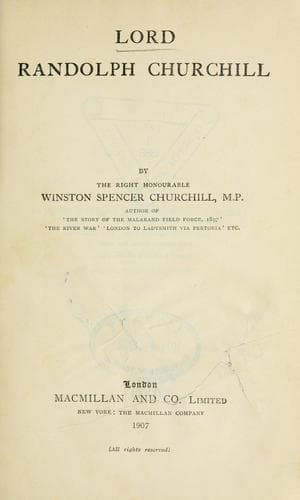
Churchill, Randolph Henry Spencer, Lord, 1849-1895
was not unreasonable and that he would himself endeavour to help the
Ministry by his vote and by the example of his silence. Lord Randolph,
in what is called ‘a statesmanlike tone,’ described the late Prime
Minister’s conduct as magnanimous and considerate; and a Radical motion
of want of confidence in the new Administration finding only two
supporters, the prevailing harmony remained unbroken.
The position of the Government, faced by a large majority in nominal
opposition, dependent upon Nationalist favour for the avoidance of
defeat at any moment and on any question, mistrusted by many of their
own friends, bitterly hated by Whigs and Radicals, and unable to escape
from constant humiliation by resignation or dissolution, was one of
extreme discomfort. But there seemed to be a kind of truce at
Westminster, in vivid contrast to the rising strife elsewhere. Under
such happy conditions, and with the cessation of Irish obstruction, the
end of the Session proved curiously fruitful. The Budget was
uncontroversial. The Government helped Lord Rosebery to carry his
Secretary for Scotland Bill through both Houses. Lord Salisbury passed a
measure dealing with the housing of the working classes, in spite of
some murmurings among the Peers at its socialistic flavour. Mr. Balfour
took charge of a Medical Relief Bill which ultimately became law,
although the Liberal majority ‘improved’ it to such an extent that the
Government disclaimed responsibility for it. Mutual concessions and
genuine co-operation placed both a Land Bill and a Labourers Bill for
Ireland upon the statute book. The Land Bill, or the ‘Ashbourne Act,’
as it was called, took extensive effect, and was the foundation and the
precursor of all subsequent Land Purchase Acts, culminating in the Land
Act of 1903. Sir William Harcourt and the new Home Secretary aided each
other to effect most important amendments in the criminal law; and,
finally, the Colonial Secretary, firmly refusing to allow the objections
of New South Wales to defeat the wishes of the other Australian
Colonies, succeeded in passing a Federation Bill which opened the door
to a Commonwealth of Australia. Indeed, a Parliamentary Paradise, albeit
enduring only upon sufferance, seemed to have sprung into being in the
midst of a Political Inferno. The good sense and tolerance of the nation
were gathered within the sheltering walls of Parliament, while discord,
faction, and electioneering clamour reigned supreme outside.
Public-domain text, read in full here on John Shaqi.
Reviews
Reviews
No reviews yet
Be the first to share your thoughts on this work.
Elsewhere in the archive
Join the Discussion
Join the discussion
Sign in to leave a comment or review.
Sign InorCreate an account