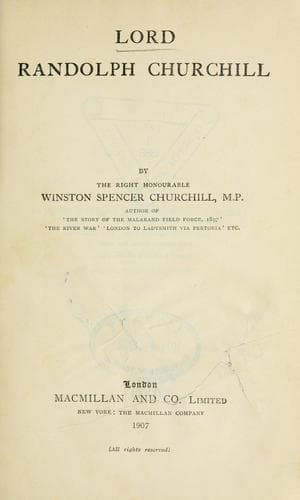
Churchill, Randolph Henry Spencer, Lord, 1849-1895
One curious legislative feat must be recorded. An Irish Educational
Endowments Bill had been brought down from the Lords and read a first
time in the Commons early in the session (May 12) as one of Mr.
Gladstone’s Government Bills. It had been practically abandoned before
the change of Ministry. Not one of the members of the new Government had
read a line of it; but Lord Randolph--interested as ever in Irish
education--was persuaded by FitzGibbon, in the early days of August,
that the Bill might be so altered as to make a useful measure and he
exerted himself to salve the derelict. The difficulties seemed
insuperable. The Chief Secretary for Ireland, Sir William Hart-Dyke,
indignant at a proposal to introduce important legislation in the last
week of the last session of an expiring Parliament, refused to have
anything to do with it. The Leader of the House only consented to allow
the attempt upon the condition that the session should not be prolonged
by a single day. The Bill had to be redrafted from beginning to end. It
could not be advanced a stage without the concurrence of the Nationalist
party. Three or four perfectly distinct and usually antagonistic
sections of Irish opinion had to be conciliated and the negotiations
between Lord Randolph and FitzGibbon on the one hand, and Mr. Sexton and
Mr. Healy on the other, afforded some beautiful specimens of Hibernian
diplomacy. All obstacles were surmounted. The Irish Attorney-General,
Mr. Holmes--with whom Lord Randolph had made friends--undertook the
conduct of the redrafted Bill. It was read a second time on August 11.
The amendments, covering whole pages of the order paper, entirely
altering the Bill from its original shape, unintelligible to everyone
except the Minister who moved them and the two or three Irish members
who discussed them, were considered on the 12th. On the 13th the Bill
was recommitted, to introduce the necessary money clauses, read a third
time and sent to the House of Lords: and the next day, on which the
session closed, it passed and received the Royal Assent. None of its
thirty-eight sections have given rise to any difficulty and during the
nine years which followed its passing it was constantly renewed until
the endowments and management of upwards of 1,350 Primary Schools and
more than 100 Intermediate and Collegiate Institutions had been
reorganised under its operation.
Mr. Holmes, the Attorney-General, like many others who worked under Lord
Randolph Churchill, became warmly attached to him. Their joint labours
on this Bill impressed him with the extraordinary power of conciliating
persons and overcoming difficulties possessed by a man so often
associated only with violence. Above all he admired his courage. ‘I
feel,’ he wrote two years afterwards, when the leader of Tory Democracy
was leader no more, ‘like one of Rupert’s soldiers serving under a Dutch
Burgomaster.’
Public-domain text, read in full here on John Shaqi.
Reviews
Reviews
No reviews yet
Be the first to share your thoughts on this work.
Elsewhere in the archive
Join the Discussion
Join the discussion
Sign in to leave a comment or review.
Sign InorCreate an account