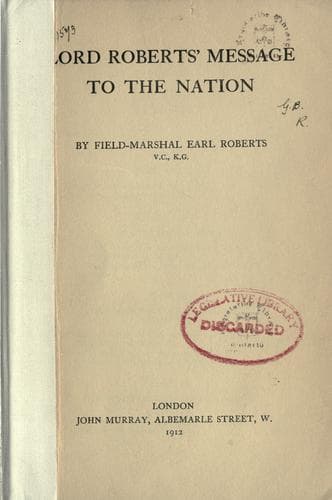
Lord Roberts' Message to the NationRoberts, Frederick Sleigh Roberts, Earl
History
Lord Roberts' Message to the Nation
Roberts, Frederick Sleigh Roberts, Earl
Great Britain -- Defenses; Great Britain. Army
[1] In the course of the controversies raised by my Manchester speech
the fallacy of the superiority of the volunteer to "the unwilling
conscript" has once more reappeared. I must here repeat what I said in
the House of Lords in April, 1911, that much of this talk about "one
volunteer being worth two pressed men" is nonsensical. The truth is
that one man, whether pressed or not, if well disciplined and carefully
trained, is worth at least half a dozen undisciplined, insufficiently
trained volunteers. No doubt, if I had to lead a forlorn hope
requiring men determined to carry out the job, no matter what the odds
against them might be, I would rather have half the number of men who
volunteered than double the number ordered to perform it, provided all
were equally well trained; but if it were a question of soldiers versus
untrained volunteers, I would infinitely prefer to have ten
well-trained and well-disciplined soldiers than fifty ill-trained and
ill-disciplined volunteers.
I could give many instances from history in support of this view--the
opinions of great commanders like Washington and Napoleon--but I will
here cite only one incident from my own experience of war:
During the Franco-German War of 1870-71, the French, from having an
army without any means of expansion, were forced, after the first few
weeks, to employ hastily-raised levies. These levies, even in greatly
superior numbers, were no match for the highly-trained German soldiers.
On one occasion towards the end of the war, 35,000 German soldiers
found themselves engaged with a force of these recently-raised levies,
numbering between 140,000 and 150,000. They had been given such
training as was possible while war was going on, for four and a half
months. They were brave men fighting for their own country, and in
their own country, and what happened? Within a month 60,000 of them
were killed, wounded, prisoners, or missing, while the remaining 80,000
were driven over the Swiss frontier and there interned.
[2] And as regards the much-needed six months' training, supposing, for
argument's sake, that we could calculate on being given six months'
warning, can we feel absolutely certain that the few patriotic
employers who have allowed their men to join the Territorial Army, and
are good enough to spare them for a week's or fortnight's training
yearly, would or could consent to their being taken away for six
months, during which time their business would go to pieces, while
their competitors in trade, who have refused to allow their men to
serve their country, would be reaping great benefit from their
selfishness and want of patriotism?
PART III
THE NATIONAL SERVICE LEAGUE AND THE WORKING CLASSES
INTRODUCTORY NOTE.
Public-domain text, read in full here on John Shaqi.
Reviews
Reviews
No reviews yet
Be the first to share your thoughts on this work.
Join the Discussion
Join the discussion
Sign in to leave a comment or review.
Sign InorCreate an account