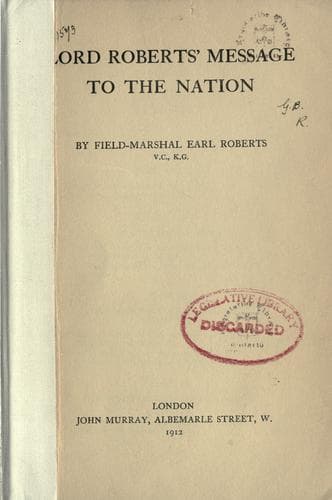
Lord Roberts' Message to the NationRoberts, Frederick Sleigh Roberts, Earl
History
Lord Roberts' Message to the Nation
Roberts, Frederick Sleigh Roberts, Earl
Great Britain -- Defenses; Great Britain. Army
I here insert a letter on the political situation, which I wrote to the
_Times_ a year ago. This letter, I hope, will serve to show that the
National Service League has at least considered the effects which
National Service in Arms would have upon the working men of this
country.
The assertion advanced by Mr. Blatchford in criticizing my Manchester
speech, that the working men of Great Britain will never hear of
compulsory service because they distrust the ruling classes, rests upon
a misconception of the English Constitution almost too obvious to
require exposure. This subject has already been dealt with in Part
III. of "Fallacies and Facts" (pp. 208-217), and to that work I must
refer the reader. I shall only observe in this place that in a
democratic nation the working classes are themselves the ruling
classes, and that the interests of England and of the Empire are their
interests. Does Mr. Blatchford really imagine that the working men are
so blind that, rather than defend those interests like men, they will
prefer tamely to hand them over to Germany or to any other foreign
Power? For this, and this only, is the logical consequence of his
assertion, that he and his fellow-workers prefer invasion to universal
compulsory service.
In former times, when the ruling classes of this nation consisted in
very deed of the men of birth and property, that class considered it as
its sacred right and inalienable privilege to serve the nation in war.
Now, in the twentieth century, when the working men of this country
have by the gradual extension of the franchise succeeded to the
political influence and supremacy of the old aristocratic class, is it
too much to hope that, as their condition of life improves, they will
seek in the same spirit to secure that right and that inalienable
privilege--service in war? For such service is the only mark of the
true and perfect citizenship.
Surely that were a greater path and to a nobler goal than the path and
the goal prescribed to the workers of this nation by the criticism in
the _Clarion_, to which I have just referred.
NATIONAL SERVICE AND SOCIAL REFORM.
TO THE EDITOR OF THE "TIMES."
SIR,
The notification in the _Times_ that Lord Selborne will shortly address
a meeting in London on Imperial unity has caused me to reflect very
seriously on what Imperial unity means to us, and on the disastrous
effects that must follow any diminution on the part of the oversea
Dominions in the splendid feeling of loyalty to the Mother Country of
which we have quite recently had such a convincing example.
Public-domain text, read in full here on John Shaqi.
Reviews
Reviews
No reviews yet
Be the first to share your thoughts on this work.
Join the Discussion
Join the discussion
Sign in to leave a comment or review.
Sign InorCreate an account