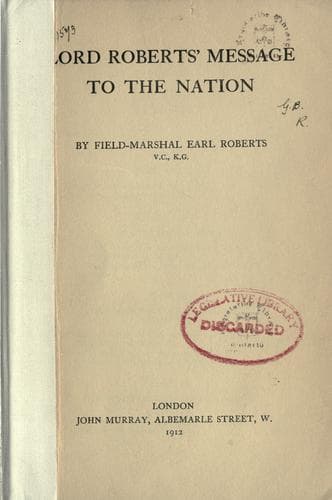
Lord Roberts' Message to the NationRoberts, Frederick Sleigh Roberts, Earl
History
Lord Roberts' Message to the Nation
Roberts, Frederick Sleigh Roberts, Earl
Great Britain -- Defenses; Great Britain. Army
Nor, in more recent times, has Manchester abated her zeal or her vital
energy in every phase of English political life. The greatest, most
temperate, and statesmanlike Liberal newspaper in England is night by
night printed within your walls; so that, at least in one phase of our
national life and amongst one group of our fellow-citizens--the Liberal
party, that is to say--it is literally true that what Manchester thinks
to-night London thinks to-morrow. And a certain election the other
day, and the overflow meetings which, I understand, have been held in
favour of Tariff Reform within the sacred precincts of the Free Trade
Hall itself, give a further proof that here in Manchester you are not
petrified in your opinions, but that the stream of your political life
flows fresh and from the fountain-head.
Judge then, gentlemen, whether it was not with some concern that I
looked forward to this occasion; judge whether it was not with some
searching of the heart that I reflected upon what I have this afternoon
to say to you. For does it not appear at first sight as if what I have
to say is not merely antagonistic to the teaching of the two greatest
names of the Manchester School, John Bright and Richard Cobden, but is
in every way the contradiction of the characterizing ideas and the
traditions associated with this city itself?
For I come before you to-day to advocate the necessity of National
Service; to affirm once more that the "Nation in Arms" is the only
worthy and sure bulwark of this Empire and these islands.[2] Cobden,
on the other hand, has left it on record that he considered it the
glory and the exceeding great reward of all his labours that he had
contributed, in however small a degree, to that universal disarmament
of Europe, which, he sanguinely hoped, would be the result of Free
Trade and of expanding commerce and the organization of labour. And
John Bright, his great colleague, in one speech after another, added
the lustre of his eloquence to that same high and flattering
anticipation. I can remember easily the ardent and sympathetic
reception which those anticipations met in the France of Louis
Napoleon; I can remember also the added weight which France's
enthusiasm gave to those happy anticipations here in England. War,
indeed, seemed at an end. To-morrow, it seemed, we should be turning
our barracks into granaries and our arsenals into banking houses.
Public-domain text, read in full here on John Shaqi.
Reviews
Reviews
No reviews yet
Be the first to share your thoughts on this work.
Join the Discussion
Join the discussion
Sign in to leave a comment or review.
Sign InorCreate an account