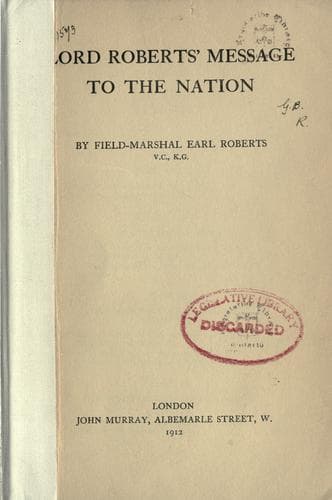
Lord Roberts' Message to the NationRoberts, Frederick Sleigh Roberts, Earl
History
Lord Roberts' Message to the Nation
Roberts, Frederick Sleigh Roberts, Earl
Great Britain -- Defenses; Great Britain. Army
Gentlemen, I am, I trust, doing no wrong to the memory of these
statesmen when I point out that in the very years--nay, in the very
months--that they were cherishing these illusions of peace and
universal disarmament, in those very months the mightiest and most
disciplined force that this earth has ever contained was silently being
drilled in that wide region from the Rhine to the Elbe and the Oder,
and from the North Sea to the Bavarian frontier, until, the right hour
having struck, that army disclosed itself in all its prodigious and
crushing mass and in all its unmatched capacity for destruction and
war. And, amid those auspicious dreams of peace, for what was that
army being trained? Koeniggrätz, Metz, St. Privat, and Sedan are the
answer. Nor did that army pause until upon the ruins of the Empire of
the third Napoleon--upon the ruins, I may say, of France, unprepared in
peace, and in war scattered and dismayed--it had reared a new Empire,
the Empire of William I., of Frederick I., and of William II., for
whose personal character, noble and imaginative patriotism, and
capacities as a ruler, I yield to no man in my admiration. Such,
gentlemen, was history's ironic comment upon John Bright's and Richard
Cobden's eloquently-urged enthusiasm. Let me not increase by any word
of mine the crushing weight of Destiny's criticism.
Now, gentlemen, at the present day, now in the year 1912, our German
friends, I am well aware, do not, at least in sensible circles, assert
dogmatically that a war with Great Britain will take place this year or
next; but in their heart of hearts they know, every man of them,[3]
that, just as in 1866 and just as in 1870, war will take place the
instant the German forces by land and sea are, by their superiority at
every point, as certain of victory as anything in human calculation can
be made certain. "Germany strikes when Germany's hour has struck."
That is the time-honoured policy of her Foreign Office. That was the
policy relentlessly pursued by Bismarck and Moltke in 1866 and 1870; it
has been her policy decade by decade since that date; it is her policy
at the present hour. And, gentlemen, it is an excellent policy. It
is, or should be, the policy of every nation prepared to play a great
part in history. Under that policy Germany has, within the last ten
years, sprung, as at a bound, from one of the weakest of naval Powers
to the greatest naval Power, save one, upon this globe. But yesterday,
so to speak, the British Fleets did not feel the furrow of a German
war-keel on the wide seas. To-day every British warship and every
British merchant vessel thrills in all her iron nerves to that mighty
presence. Just as in 1866, by the massing of her armies towards this
frontier or towards that frontier, Prussia controlled the action of
Austria, so Germany constrains the action of England at the present
day. Do you wish for proofs? I point to the gradual displacement of
Public-domain text, read in full here on John Shaqi.
Reviews
Reviews
No reviews yet
Be the first to share your thoughts on this work.
Join the Discussion
Join the discussion
Sign in to leave a comment or review.
Sign InorCreate an account