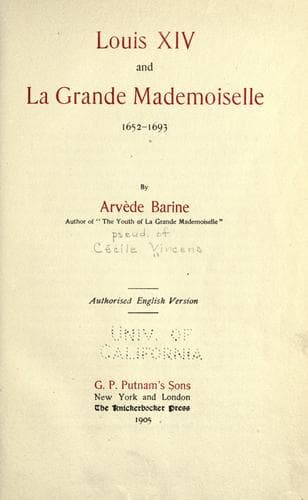
Louis XIV and La Grande Mademoiselle, 1652-1693Barine, Arvède
History
Louis XIV and La Grande Mademoiselle, 1652-1693
Barine, Arvède
Louis XIV, King of France, 1638-1715; Montpensier, Anne-Marie-Louise d'Orléans, duchesse de, 1627-1693
La Fontaine has treated the same subject in three of his fables. It is
in one of these, _Les Devineresses_, published in 1678, consequently
before the famous drama _Les Poisons_, in which he shows himself very
well acquainted with what the police had not yet been sufficiently
clever to discover. He knew marvellously well the existence of the
_poudre de succession_ and of the _poudre pour l'amour_:
Une femme, a Paris, faisait la pythonisse.
On l'allait consulter sur chaque evenement;
Perdait-on un chiffon, avait-on un amant,
Un mari vivant trop, au gre de son epouse,
Une mere facheuse, une femme jalouse,
Chez la Devineuse on courait,
Pour se faire annoncer ce que l'on desirait.
The warning was not heeded, and it needed the "burning chamber" of 1680
to make honest people comprehend that "clairvoyant" was too often
another name for "seller of poisons." La Fontaine had, however, given no
new information about the confidence inspired. This fact was already too
well known.
This dangerous agency, of which we have already had a glimpse on the
occasion of the first search for Lesage and Mariette, merits some
descriptive details. In Paris, during a period of twenty years, it was
so mixed up with intrigues and crimes that it exercised a real influence
over the morals of the Parisian world and through it over the affairs at
Court.
Like a wave of madness it swept over the heads especially of the women.
Many of these, even those not directly mingling in political life, were
in a state of revolt, inconsolable for having lost the importance
acquired during the civil troubles.
Women had been emancipated by the force of affairs. During the actual
fighting and the general disorders which ensued, the habit of remaining
in the shade of obedience was lost; also the considering themselves only
as objects of luxury.
Louis XIV. had undertaken the task of bringing the sex back to the
playing of a decorative or utilitarian role. It was almost as if to-day
we should demand of our daughters, so free, so mingled with the general
movement, to return suddenly to the self-effacement and the thousand
restraints of our own youth. They would be transported with rage.
In 1666, the larger portion of the clients of the necromancer sought
above everything else a secret by the aid of which they might shake off
the yoke that had again fallen upon their shoulders. The husband was the
natural incarnation of this yoke. It was therefore against him that the
revolt was habitually directed. The wives addressed themselves to a
clairvoyant. The first consultation was generally innocent enough.
Public-domain text, read in full here on John Shaqi.
Reviews
Reviews
No reviews yet
Be the first to share your thoughts on this work.
Elsewhere in the archive
Join the Discussion
Join the discussion
Sign in to leave a comment or review.
Sign InorCreate an account