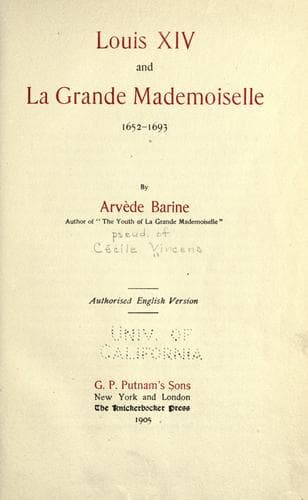
Louis XIV and La Grande Mademoiselle, 1652-1693Barine, Arvède
History
Louis XIV and La Grande Mademoiselle, 1652-1693
Barine, Arvède
Louis XIV, King of France, 1638-1715; Montpensier, Anne-Marie-Louise d'Orléans, duchesse de, 1627-1693
During the sharpest quarrel between Mademoiselle and Mme. de Montespan,
the enjoyment of the opponent's wit was so keen that they parted with
pain. "Mme. de Montespan and I," wrote Mme. de Maintenon in 1681,[204]
"have to-day taken a walk, holding each other's arms and laughing
heartily; we are not more in accord for this." There can never be too
much cleverness, but there is an inconvenience in there being nothing
behind the wit, and this is one of the rocks towards which Louis XIV.
was pushing the French nobility. He made it impossible for those pacing
his antechambers to indulge in any intellectual effort other than that
of seeking pretty phrases to amuse the listeners.
A gentleman of quality commences his day at eight in the morning
standing in waiting before the door of the king. Salutes are given and
returned. The elegants comb their locks, glancing out of the corner of
their eyes at those entering. Moliere permits us to be present at the
"final assault" through verses but little known:
Grattez du peigne a la porte[205]
De la chambre du Roi;
Ou si, comme je prevoi,
La presse s'y trouve forte,
Montrez de loin votre chapeau,
Ou montez sur quelque chose
Pour faire voir votre museau,
Et criez sans aucune pause,
D'un ton rien moins que naturel;
"Monsieur l'huissier, pour le marquis un tel"
Jetez-vous dans la foule, et tranchez du notable,
Coudoyez un chacun, point du tout quartier,
Pressez, poussez, faites le diable
Pour vous mettre le premier.[206]
M. le Marquis enters. The chamber is already crowded. He "gains ground
step by step," succeeds in seeing the King put on his shoes, for Louis
performs this act with his own royal hands, and thus passes the first
hour. The exciting event is repeated in the evening when the King takes
off his shoes. The Marquis had already, at one o'clock, witnessed the
consumption of the royal soup, and two or three times in the course of
the day had delighted his eyes with the sight of the King passing to
and fro on his way to mass or to take the fresh air.
During the intervals, the courtiers were charged with certain puerile
occupations. The round of homages were made to the various members of
the royal family and the prominent personages of the day, and there was
gambling and other pleasures. The only relief for this complete idleness
was to be found in an active campaign if there happened to be a war on
hand. Let the courtier be admired for being able under such adverse
circumstances to keep his wit awake and alert for attack and response,
and also for the capacity of finding the military virtues when again
called upon to exercise them.
Public-domain text, read in full here on John Shaqi.
Reviews
Reviews
No reviews yet
Be the first to share your thoughts on this work.
Elsewhere in the archive
Join the Discussion
Join the discussion
Sign in to leave a comment or review.
Sign InorCreate an account