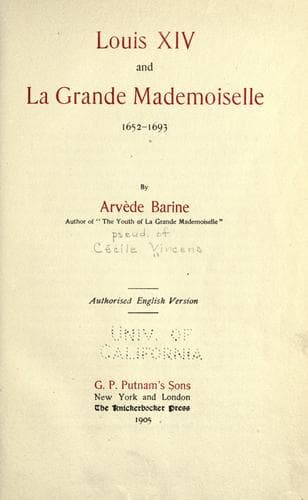
Louis XIV and La Grande Mademoiselle, 1652-1693Barine, Arvède
History
Louis XIV and La Grande Mademoiselle, 1652-1693
Barine, Arvède
Louis XIV, King of France, 1638-1715; Montpensier, Anne-Marie-Louise d'Orléans, duchesse de, 1627-1693
Court life, nevertheless, pursued its monotonous course, and Mme. de
Montespan continued to figure in positions of honour. In March, 1689,
she goes to meet the Dauphin[293] with the rest of the Court, and it is
she who has charge of the choice and arrangement of the wedding
presents, "being the woman in the world," wrote Mademoiselle, "who knows
the best forms." In July, the King led her to Versailles with her
sister, Mme. de Thianges, and her niece, the beautiful Duchesse de
Nevers. This lady the mother and aunt were cynically offering to the
Monarch.[294] In February, 1681, "a lottery was opened at Mme. de
Montespan's, of which the largest prize was one hundred thousand francs,
and there were a hundred others offered of one hundred pistoles each."
In July, 1682, the _Chambre ardente_ was suddenly suppressed. Of the
three hundred accused, thirty-six people of no importance had been
executed, one hundred sent to the galleys, or to prisons, or convents,
or exiled; the noted among them always gaining some concessions. The
dungeons of Paris and Vincennes were crowded. The smaller fry were
released, and the remainder were scattered, without any other trial,
through the provincial prisons, to await a death rarely slow in coming
to relieve their misery.
From Louvois to M. de Chauvelin, Intendant, December 16, 1682,
announcing the arrival of one of these convoys:
Above all, please take care to prevent any of these gentlemen
from proclaiming aloud, a thing which has already occurred, any
of the absurd statements connected with Mme. de Montespan,
which have been proved to be absolutely without foundation.
Threaten a punishment so severe at the first utterance that
they will not dare to breathe a word further.
This letter ended the connection of Mme. de Montespan with the affair of
the "corrupters of morals" or the poisoners. She was saved, but was this
due to proofs of innocence or to reasons of State, to the refusal of
Louis to credit the testimony of an Abbe Guibourg or Lesage, or to the
remnants of an old tenderness? The few men with whom it had been
necessary to share the secrets which would respond to these questions
were so perfectly mute that contemporaries suspected nothing. They saw
the ancient favourite a little neglected, but always dreaming of the
possibility of reasserting herself, as the many pages of the _Memoires_
of Mademoiselle testify. All this was in the natural course of events.
Public-domain text, read in full here on John Shaqi.
Reviews
Reviews
No reviews yet
Be the first to share your thoughts on this work.
Elsewhere in the archive
Join the Discussion
Join the discussion
Sign in to leave a comment or review.
Sign InorCreate an account