At the same time, however, it began to be seen that these demands,
important as they are, by no means cover the whole ground, while,
taken separately, they were liable to lead in a false direction; they
tended to masculinise women and they ignored the claims of the race.
In their ardour for emancipation, women sometimes seemed anxious to
be emancipated from their sex. Thus it was not enough to claim woman’s
place as a human being—especially in an age when man was regarded
as the human being _par excellence_—but it also became necessary to
claim woman’s place in the world as a woman. That was not, as it might
at first seem, a narrower but a wider claim. For on the merely human
basis women were reduced to the level of competitive struggle with men,
were allowed to bring no contribution of their own to the solution of
common problems, and, worst of all, their supreme position in the world
as mothers of the race was altogether ignored. So that the assertion
of the essential rights of women as women meant at the same time the
assertion of the rights of society and the race to the best that women
have to give. It was certainly by no accident that the Germans, who
once before led the evolution of Europe by their triumphant assertion
of the fundamental human impulses and have since been pioneers in
social organisation, should take the leading part in the inauguration
of this new phase of the woman movement.
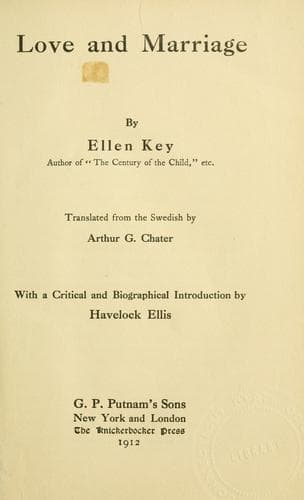
The publication of Ellen Key’s books corresponded in date with the
recent tendency of the Germans to bring to bear on the questions of sex
their characteristic Teutonic thoroughness and practicality. It is not
surprising, therefore, that this Swedish woman, with her many-sided
vision of the world, her daring yet serene statement of the secrets of
human hearts, should be greeted as the natural leader of the movement
on its most womanly side. Love, as Ellen Key regards it, is at the core
of the woman question, and these opening volumes of _Lifslinger_ are,
above all, a contribution to the woman question, a modern and more
mature version of that _Vindication of the Rights of Woman_ which Mary
Wollstonecraft had set forth a century earlier.
Public-domain text, read in full here on John Shaqi.
Reviews
Reviews
No reviews yet
Be the first to share your thoughts on this work.
Join the Discussion
Join the discussion
Sign in to leave a comment or review.
Sign InorCreate an account