In England, and the same may be said of America, we are yet but at
the beginning of this new phase of the woman movement. We have been
mainly concerned with the rights of women to be like men; we are only
now beginning to understand the rights of women to be unlike men,
rights which, as Ellen Key understands them, include, although they
go beyond, the rights embodied in the earlier claims. The dogmatic
fanatics of every party, it is true, cannot endure Ellen Key; they
cannot understand her, though she understands them, and even regards
them with a certain sympathetic tolerance, as we should expect from a
disciple of Montaigne and Shakespeare and Goethe. She is many-sided and
is quite able to see and to accept both halves of a truth. In one of
her earliest essays she showed how individualism and socialism, which
some people suppose to be incompatible, are really woven together,
and in the same way she now shows that eugenics and love—the social
claims of the race and the individual claims of the heart —are not
opposed but identical. Similarly, she declares that to build up, to
help, to console is the greatest of women’s rights; but, she adds,
they cannot adequately exercise that right unless they also possess
the right of citizenship—so disconcerting the narrow partisan on each
side. In matters of detail we may at many points reserve our opinion.
Ellen Key is, above all,—like Olive Schreiner, to whom she is, in
some respects, akin—the prophet of a movement which transcends merely
isolated measures of reform. Her writings are the candid expression of
her intimate self. In this book, especially, we feel that we are in the
inspiring presence of a woman whose personality is one of the chief
moral forces of our time.
[Illustration: Signature of Havelock Ellis]
LONDON, September, 1910.
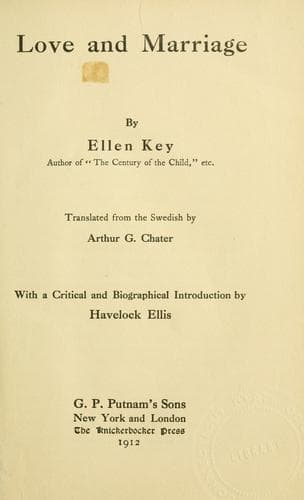
Love and Marriage
CHAPTER I
THE COURSE OF DEVELOPMENT OF SEXUAL MORALITY
All thoughtful persons perceive that the ideas of the morality of
sexual relations upheld by the religions and laws of the Western
nations are in our time undergoing a radical transformation.
Like all other such changes, this one is opposed by the distrust of
the guardians of society, a distrust which is based upon the view that
human beings lack the power of themselves directing their development
on an upward course. According to these critics, this direction is the
concern of transcendental reason, which expresses itself in the real
and thus causes the real to become rational. Marriage as it exists is a
historically produced reality, and therefore also rational. Historical
continuity—as well as religious and ethical needs—must entail the
permanence of the actual institution of marriage as an indispensable
condition of the existence of society.
Public-domain text, read in full here on John Shaqi.
Reviews
Reviews
No reviews yet
Be the first to share your thoughts on this work.
Join the Discussion
Join the discussion
Sign in to leave a comment or review.
Sign InorCreate an account