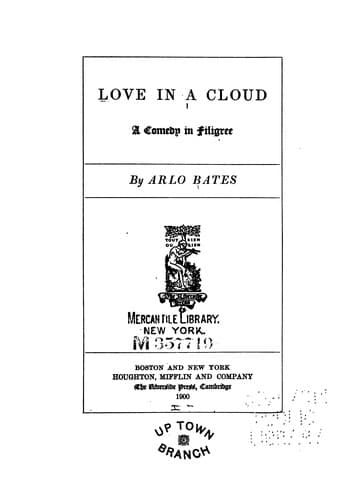
Anonyms and pseudonyms -- Fiction; Authorship -- Fiction; Boston (Mass.) -- Social life and customs -- Fiction
"Well, Alice," Mrs. Harbinger said, "I am glad you have come at last. I
began to think that I must appoint a substitute to pour in your place."
"I am sorry to be so late," Miss Endicott responded, as she and her
hostess exchanged places. "I was detained unexpectedly."
"I kept her," Miss Wentstile announced with grim suddenness. "I have
been talking to her about--"
"Aunt Sarah," interposed Alice hurriedly, "may I give you some tea?"
"Don't interrupt me, Alice. I was talking to her about--"
Mrs. Harbinger looked at the crimsoning cheeks of Alice, and meeting
the girl's imploring glance, gave her a slight but reassuring nod.
"My dear Miss Wentstile," she said, "I know you will excuse me; but here
are more people coming."
Miss Wentstile could hardly finish her remarks to the air, and as Mrs.
Harbinger left her to greet a new arrival the spinster turned sharply to
May Calthorpe, who had snuggled up to Alice in true school-girl fashion.
"Ah, May," Miss Wentstile observed, "what do you settle down there for?
Don't you know that now you have been brought out in society you are
expected to make your market?"
"No, Miss Wentstile," May responded; "if my market can't make itself,
then it may go unmade."
The elder turned away with another characteristic sniff, and Alice and
May were left to themselves. People were never tired of condemning Miss
Wentstile for her brusque and naked remarks; but after all society is
always secretly grateful for any mortal who has the courage to be
individual. The lady was often frank to the verge of rudeness; she was
so accustomed to having her own way that one felt sure she would insist
upon it at the very Judgment Seat; she said what she pleased, and
exacted a deference to her opinions and to her wishes such as could
hardly under existing human conditions be accorded to any mortal. Miss
Wentstile must have been too shrewd not to estimate reasonably well the
effect of her peculiarities, and no human being can be persistently
eccentric without being theatrical. It was evident enough that she
played in some degree to the gallery; and undoubtedly from this it is to
be argued that she was not without some petty enjoyment in the notoriety
which her manners produced. Should mankind be destroyed, the last thing
to disappear would probably be human vanity, which, like the grin of the
Cheshire cat in "Alice," would linger after the race was gone. Vanity in
the individual is nourished by the notice of others; and if Miss
Wentstile became more and more confirmed in her impertinences, it is
hardly to be doubted that increase of vanity was the cause most active.
She outwardly resented the implication that she was eccentric; but as
she contrived continually and even complacently to become steadily more
so, society might be excused for not thinking her resentment
particularly deep. Dislike for notoriety perhaps never cured any woman
of a fault; and certainly in the case of Miss Wentstile it was not in
the least corrective.
Public-domain text, read in full here on John Shaqi.
Reviews
Reviews
No reviews yet
Be the first to share your thoughts on this work.
Join the Discussion
Join the discussion
Sign in to leave a comment or review.
Sign InorCreate an account