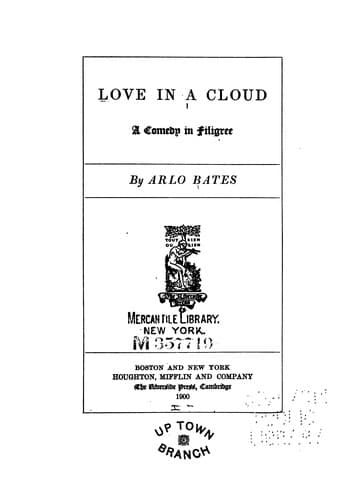
Love in a Cloud: A Comedy in Filigree — John Shaqi
Love in a Cloud: A Comedy in FiligreeBates, Arlo
General
Love in a Cloud: A Comedy in Filigree
Bates, Arlo
Anonyms and pseudonyms -- Fiction; Authorship -- Fiction; Boston (Mass.) -- Social life and customs -- Fiction
The relations between Miss Wentstile and Alice Endicott were well known.
Alice was the doubly orphaned daughter of a gallant young officer killed
in a plucky skirmish against superior force in the Indian troubles, and
of the wife whose heart broke at his loss. At six Alice was left, except
for a small pension, practically penniless, and with no nearer relative
than Miss Wentstile. That lady had undertaken the support of the child,
but had kept her much at school until the girl was sixteen. Then the
niece became an inmate of her aunt's house, and outwardly, at least,
the mere slave of the older lady's caprices. Miss Wentstile was kind in
her fashion. In all that money bought she was generous. Alice was richly
dressed, she might have what masters she wished, be surrounded by
whatever luxuries she chose. As if the return for these benefits was to
be implicit obedience, Miss Wentstile was impatient of any show toward
herself of independence. If Alice could be imagined as bearing herself
coldly and haughtily toward the world in general,--a possibility hardly
to be conceived of,--Miss Wentstile might be pictured glorying in such a
display of proper spirit; but toward her aunt the girl was expected to
be all humility and concession. As neither was without the pride which
belonged to the Wentstile blood, it is easy to see that perfect harmony
was not to be looked for between the pair. Alice had all the folly of
girlhood, which is so quick to refuse to be bullied into affection;
which is so blind as not to perceive that an elder who insists upon its
having no will of its own is providing excellent lessons in the high
graces of humility and meekness. Clever observers--and society remains
vital chiefly in virtue of its clever observers--detected that Miss
Wentstile chafed with an inward consciousness that the deference of her
niece was accorded as a courtesy and not as a right. The spinster had
not the tact to avoid betraying her perception that the submission of
Alice was rather outward than inward, and the public sense of justice
was somewhat appeased in its resentment at her domineering treatment by
its enjoyment of her powerlessness either to break the girl's spirit or
force her into rebellion.
Public-domain text, read in full here on John Shaqi.
Reviews
Reviews
No reviews yet
Be the first to share your thoughts on this work.
Join the Discussion
Join the discussion
Sign in to leave a comment or review.
Sign InorCreate an account