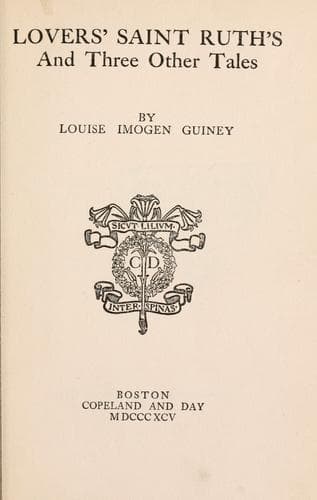
Lovers' Saint Ruth's, and Three Other TalesGuiney, Louise Imogen
General
Lovers' Saint Ruth's, and Three Other Tales
Guiney, Louise Imogen
American fiction -- 19th century; Short stories, American
MORNING lay over Portsmouth and her great stretches of opaline sea. The
little islands, north to the Maine shore, and east to the harbor-buoys,
were ablaze with red and yellow bushes to the water-brink; the
low-masted gunlows were beating out like a flock of dingy gulls; and
from afar, pleasantly, musically, sounded the bugle at the Navy Yard.
The Honorable Langdon Openshaw, standing among ruinous warehouses and
wharves, built by the Sheafes in the hour of their commercial glory
under the second George, looked down upon the clear Piscataqua at
full flood, breathing between its day-long, Samson-like tugs at the
yet enduring piers. It was a lonely spot; the wind had a way there,
sometimes, of waking momentary, half-imagined odors, the ghosts of the
cargoes of wines and spices in the prodigal past. His own solitude,
the washing tide, the one towering linden yonder, the gambrel roofs
and ancient gardens, the felt neighborhood of the dear wild little
graveyard where his forbears slept, steeped his heart in overwhelming
melancholy. He had already passed a week at the Rockingham. It was a
strange date to choose, out of all his free and prosperous life, for a
first visit since childhood to the fair old New England borough where
he was born. A sort of morbid home-sickness had driven him back now,
in his distresses, to her knee. For the Honorable Langdon Openshaw,
innocent of the astounding crime with which he was charged, was out on
bail.
The accusation was the most inexplicable of things. His chief
characteristic had been an endearing gentleness, which brought him the
popular favor he cared nothing for. He was the captain citizen of his
town; he had held, in turn, every office public esteem could give him;
he was president of a wealthy corporation which controlled a bank. It
was this treasury which he was said to have rifled, and its cashier
whom he was said to have murdered. No living creature was there in
all Connecticut but laughed aloud when the report began to spread;
but time and circumstantial proof sobered them, and increased the
breed of cynics and sceptics the country over. The philanthropist, the
good man, the Sunday-school paragon, forsooth, once again exposed in
all his gangrened sanctity! Two sickening circumstances, in the dark
designs of Providence, pointed at him with deadly finger. One was,
that at the time of the robbery, there was an impending crash in his
vested finances, since wholly and finally averted by his foresight and
skill; the other, that sometime before, in the discharge of duty, he
had incurred the enmity of the victim. Was it not possible, during Mr.
Openshaw's interval of anxiety, he, that is, any other than he, might
have dared retrieve his fortune, and silence the witness of his crime,
George Wheeling, found unexpectedly at his desk at midnight over his
accounts, and thrown down the stair into the vaults? But there was a
more certain and horrible evidence. He had been seen escaping; he had
been recognized.
Public-domain text, read in full here on John Shaqi.
Reviews
Reviews
No reviews yet
Be the first to share your thoughts on this work.
Join the Discussion
Join the discussion
Sign in to leave a comment or review.
Sign InorCreate an account