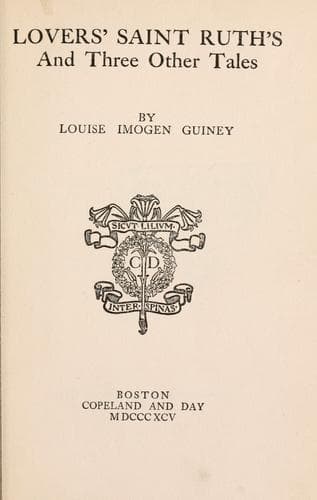
Lovers' Saint Ruth's, and Three Other Tales — John Shaqi
Lovers' Saint Ruth's, and Three Other TalesGuiney, Louise Imogen
General
Lovers' Saint Ruth's, and Three Other Tales
Guiney, Louise Imogen
American fiction -- 19th century; Short stories, American
The scuffle had roused the occupants of houses near;
and these, looking forth by the city lamplight, saw the flying figures,
one of them, alas, inconceivably, yet unmistakably, so help us God! the
Honorable Langdon Openshaw. Had they not a perfect unanimous knowledge,
for many years, of his face, his unique gait, his uncommon stature?
Where was there another such odd and definite physical personality? As
to the confederates, well, there were reasons, no doubt, why bravos
should be hired.
Wearily, wearily, he parted his gaze from the alluring eternity in the
river, and strolled a little distance to the warm wall, and sat down
in the late September grasses against it, like the broken man he was.
He took off his hat, a characteristic dark soft felt such as he always
wore, and the air was good upon his brow. His thoughts reverted to
old times. He had no kindred except a sister living in Santa Barbara
with her family of daughters, and between them there had never been
any marked natural affection. The distant cousin of his own whom he
had married, had borne him no children, and she was dead: a gentle,
negative soul, to whom he confided little of what touched him most. He
had formed no intimate companionships. No one save his mother, whom he
lost in his boyhood, and whose maiden name he bore, had ever possessed
much influence over him. He was a man's man, as the saying is, hitherto
of any age he chose, and rich in all resources. But he had strong
dormant affections, shamefacedly expended on public orphanages and
hospitals, and on the Society for the Prevention of Cruelty to Animals;
and he felt rightly that he could have been fatherly, brotherly, even
filial, with a son. Ah, if he but had a son! Bulwarked about with
modern conveniences, that, his one necessary, he had missed. And here,
in strange opprobrium, was the end of his career and of his name.
"Lover and friend hast Thou put far from me!" he breathed to himself,
feeling, for the first time since his calamity, a profound submission
of the soul.
He heard voices in the windless air. He did not rise, for they were not
approaching him. He could not help distinguishing the animated words.
"This is as far as I ought to go. I guess I'll say good-bye."
"They will miss you notta yet. Oh, please do, please do stay! I starve
if I am absent. Come, one kissa more."
"No; wait till to-morrow, you great baby. Go away now, and do your best
to be good."
"Alla righta; if you give to me one little song."
"Truly?"
"Truly, Anita mia. I desire indeed, this hour, the mandolin. But no
matter: sing. All is quiet: see! it can begin."
Then the girl's thin bird-like voice soared alone, not in any expected
love-lyric of the seaport streets, but in a Christian folk-song of
artless beauty.
"All in the April evening,
April airs were abroad;
The sheep with their little lambs
Passed me by on the road.
Public-domain text, read in full here on John Shaqi.
Reviews
Reviews
No reviews yet
Be the first to share your thoughts on this work.
Join the Discussion
Join the discussion
Sign in to leave a comment or review.
Sign InorCreate an account