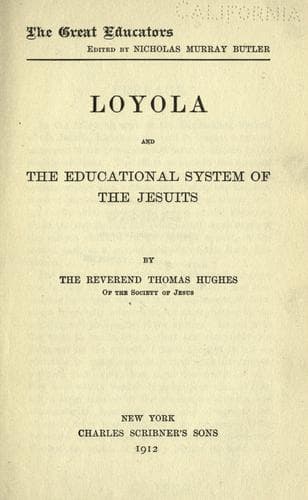
Loyola and the Educational System of the Jesuits — John Shaqi
Loyola and the Educational System of the JesuitsHughes, Thomas
History
Loyola and the Educational System of the Jesuits
Hughes, Thomas
Education -- History; Ignatius, of Loyola, Saint, 1491-1556; Jesuits
But before he can teach men, or mould teachers of men, or even conceive
the first idea of legislating for the intellectual world, he must
himself first learn. There are two fundamental lessons which he does
learn, and they go to form him. One is that, among all pursuits, the
study of virtue is supreme; the other, that, supreme as virtue is,
yet, without secular learning, the highest virtue goes unarmed, and
at best is profitable to oneself alone. He learns these two lessons,
not only in theory, but in practice. To accomplish the purpose of the
latter, he takes his seat upon the scholars' bench, and begins to learn
with little children. Though he may not meet with brilliant success in
the art of learning, still in the art of understanding what learning
is, and in the lessons of experience, he becomes a finished scholar.
He remains even then too much of a chevalier to give up a cherished
idea of his about a spiritual crusade in the East. And it is only when
thwarted in this project that, like a true knight, he simply turns
to another side of the field. He stays in the West. He is still the
Captain of a Company. But he becomes also a legislator among doctors;
and, amid his other works, he effects an educational reform.
In his whole campaign, we may discern two characteristics in the
spirit of his movements. One is that of defence, the other that of
advance. His method of defence showed itself in the reassertion of old
principles, in the conservatism of morals,--a plan of campaign, which
determines the whole frame of mind, and the social construction of the
Company. It rests on the principle of upholding what is, and not moving
the ancient landmarks. On the other hand, his advance is towards the
solution of the highest questions which can interest mankind. These
formed part of the very object and direction of the Order's march. And
so it came to pass, that his Company drew to itself that class of minds
which are most powerfully arrested by the prospect of solving such
questions, especially when times are agitated. His times were agitated,
if any ever were, more so than our own, when the same questions still
must dominate. His were times of wars with Turks in the East, and
with Christians at home; of battles lost and won, with their effects
reaching into every household; of royal and imperial administrations
confused and overthrown; of new opinions without number; of the Church
losing ground along the whole line of the frontier, and withal new
worlds looming over an horizon, where from the beginning of time the
unknown had brooded in absolute darkness. At such a moment, "Defence
and Advance," or as the Papal authority expressed it in the solemn
instrument which chartered his Institute, _Defensio ac propagatio
fidei_, were stirring watchwords to men of parts, who felt restive
under the inactivity and inefficiency of older methods, on older lines.
Public-domain text, read in full here on John Shaqi.
Reviews
Reviews
No reviews yet
Be the first to share your thoughts on this work.
Join the Discussion
Join the discussion
Sign in to leave a comment or review.
Sign InorCreate an account