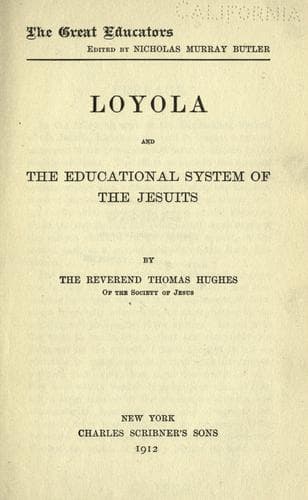
Loyola and the Educational System of the JesuitsHughes, Thomas
History
Loyola and the Educational System of the Jesuits
Hughes, Thomas
Education -- History; Ignatius, of Loyola, Saint, 1491-1556; Jesuits
I will not pause to say, that the personal poverty and exact obedience,
required in the new service, presented no obstacles to the minds
and characters which were otherwise attracted to his standard. The
antecedents of all antiquity seem to show that such conditions, to
such minds, are rather an inducement than a check. And if one takes
notice that to this was added, in the Order of Jesus, an absolute
equality, whereby every formed member binds himself to accept no
dignity within or without, or, at least, to affect no dignity at
home or abroad, which will prejudice his full franchise as a member,
then, perhaps, the attractiveness of such a life, the conservatism
and intense concentration of the Order, as well as the alacrity and
endurance manifested in the service, will not appear inexplicable to
the minds of this age, in which, under a very different form, the same
equality is called liberty, is made to construct republics, to bring
down monarchies, and develop some of the most potent agencies for
unfolding the energies of men. Yet the liberty of this latter equality
reflects but faintly, and as from a broken surface, the freedom of him,
who having liberated himself from the shackles of the world, and from
all solicitude as to his movements, office, and place, finds in turn,
as the German historian expresses it, "his own personal development
imposed upon him";[9] and, in the firm companionship of one aim,
formation, and life, enjoys the manifold support and ready sympathy of
individualities as developed as his own.
I shall narrate, in the first part, the facts of Ignatius' career,
so far as to indicate the stages of that magisterial art, by which he
himself was formed, and which then he reformed in the Jesuit _Ratio
Studiorum_. In the second part, I shall sketch briefly the history of
the _Ratio_ itself, and analyze the System as a theory and practice of
education.
CHAPTER II.
KNIGHT, PILGRIM, AND SCHOLAR.
Public-domain text, read in full here on John Shaqi.
Reviews
Reviews
No reviews yet
Be the first to share your thoughts on this work.
Join the Discussion
Join the discussion
Sign in to leave a comment or review.
Sign InorCreate an account