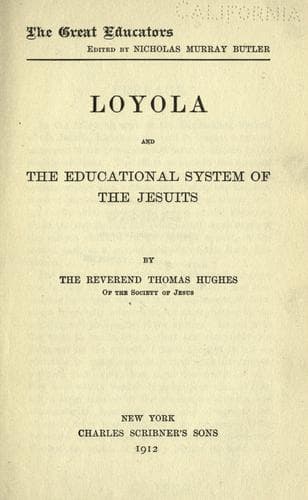
Loyola and the Educational System of the JesuitsHughes, Thomas
History
Loyola and the Educational System of the Jesuits
Hughes, Thomas
Education -- History; Ignatius, of Loyola, Saint, 1491-1556; Jesuits
This moral identity being secured, in the ways, means, and views of the
teaching body, the individual and personal elements, which each Master
brings to bear upon the work before him, are no more interfered with,
or hampered by community of method, than are all the varieties of race,
nation, politics, and environment, slighted or interfered with by a
single system of collegiate institution being placed in their midst.
It was in view of being everywhere, that the system was cast in its
precise and adjustable form, so that, in spite of being everywhere, it
should be found equally manageable and effective. And similarly, in
spite of the system itself being one, the play of individual talents
can be various, as are the movable factors in any great organization.
We may close this chapter by observing several far-reaching
consequences of the foregoing principles. In the first place, those
who, after personal experience in the classes, come to take charge
of colleges in the capacity of Rectors, are found, say the critics
of 1586, to take full and accurate account of studies and Professors
alike; for they themselves "have borne the burden of the schools, and
know how to sympathize with others from their own experience"; a fact
which is the more conducive to the end in view, as "colleges have been
instituted for the study of letters. Besides, not unfrequently there
arise in the classes, especially of the smaller colleges, difficulties
which can scarcely be overcome, except by a Rector who has personal
experience to guide him; otherwise, whether he chances to solve the
difficulty aright, or solves it awry, he will not do much good either
way, since they do not give him the credit of knowing how."[196]
The "smaller colleges" spoken of here, as more liable to encounter
internal difficulties, are contrasted elsewhere by these critics with
"the greater and principal ones, in which there are many counsellors
or referees at hand, to whom the Masters can have recourse for
assistance; and the schools themselves have sufficient authority."
But, in what they call the minor colleges, "the authority of the
schools depends for the most part on the reputation and authority of
the individual Masters," who happen at a given time to be filling the
posts.[197]
Public-domain text, read in full here on John Shaqi.
Reviews
Reviews
No reviews yet
Be the first to share your thoughts on this work.
Elsewhere in the archive
Join the Discussion
Join the discussion
Sign in to leave a comment or review.
Sign InorCreate an account