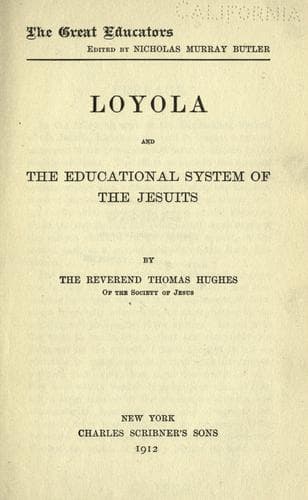
Loyola and the Educational System of the JesuitsHughes, Thomas
History
Loyola and the Educational System of the Jesuits
Hughes, Thomas
Education -- History; Ignatius, of Loyola, Saint, 1491-1556; Jesuits
In the spirit of this personal and experienced concurrence with all the
affairs of the college, the Rector is required so to moderate the other
concerns of his office, as to be prompt in fostering and advancing
all literary exercises. He is to go often to the classes, those of
the lower faculties as well as of the higher.[198] Every month, or
at least every other month, he is to hold general consultations with
all the Masters below the course of Logic, the several Prefects being
present; and, after the reading of some selection from the _Ratio_,
concerning the Masters or the piety and good conduct of the students,
he is to inquire what difficulties occur, or what omissions are noticed
in the observance of rules.[199] Books are never to be wanting, in the
sufficiency desired by the members generally, whether they are engaged
in teaching, or are pursuing their studies.[200] To this regulation,
which concerns the chief authority in a Province, the revised _Ratio_
of 1832 adds: "The same is to be said of literary periodicals for
the use of the Professors; of museums, physical apparatus, and other
equipments, which are needed by a college according to its degree."
The General Visconti observes somewhat emphatically, that "in buying
books the Rectors will never consider the money of their colleges ill
spent."[201]
Jouvancy applies the same principle to publishing the literary
productions of the Masters. He first sketches the series of literary
productions expected from them,--the annual addresses of inauguration
to be given by each Professor in his own class, the public and solemn
one to be delivered, on the same inaugural occasion, by the Professor
of Rhetoric, the poem to be composed and read by the Master of Poetry;
then, during the year, a certain number of addresses to be delivered;
and, at the end, a tragedy composed by the Professor of Rhetoric, a
minor drama by the Professor of Poetry, both to be acted on the stage.
Jouvancy goes on to recommend that no public occasion be allowed to
go by, without receiving the tribute of some such literary work.
Then he adds: "Nor is that expense to be considered useless which is
incurred for printing and publishing good poems. In all these matter,
splendors should be added to literary exercises, and to the exhibition
thereof, in such wise that everything meanwhile tends to solidity of
erudition."[202]
Public-domain text, read in full here on John Shaqi.
Reviews
Reviews
No reviews yet
Be the first to share your thoughts on this work.
Elsewhere in the archive
Join the Discussion
Join the discussion
Sign in to leave a comment or review.
Sign InorCreate an account