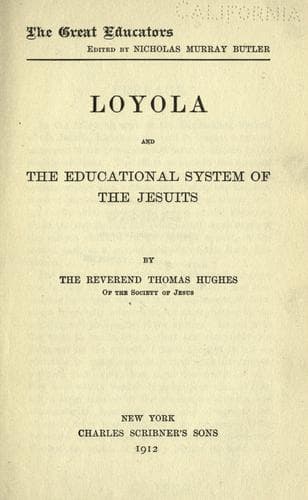
Loyola and the Educational System of the JesuitsHughes, Thomas
History
Loyola and the Educational System of the Jesuits
Hughes, Thomas
Education -- History; Ignatius, of Loyola, Saint, 1491-1556; Jesuits
Excesses of this kind being guarded against, the Fathers lay down the
thesis that, when employed in its proper place, no exercise is more
useful than disputation. You will see not a few wholly taken up with
reading, writing, arranging, and paging what they have written; but
they eschew most carefully all disputation, neglecting it, looking
upon it as an idle occupation, having all their Theology locked up,
not so much in their memory and intelligence, as in their paper books.
Men of authority, they go on to say, have always been persuaded that
Philosophy and Theology are learnt, not so much by hearing, as by
discussing. For, in this exercise, you have a most certain test how
much a man understands of what he is writing about or teaching; also
how much solidity there is in one's own private cogitations, since it
happens not unfrequently that what appears brilliant in one's private
room is seen to drag in the mud, when it comes to disputation.[256]
Then, too, while we are hard pressed by our adversary, we are forced
to strain every nerve of our wits, and, when others are bearing down
heavily upon us, we knock out of our brains many things which would
never have come into our heads, while we stayed in the quiet of leisure
and rested in the shade. We hear things which others have found out,
and which either throw light on doubtful points, or indicate the path
to some other point. Or, if what is said does not commend itself to
our judgment, we see through the opponent's artifice; we meet him with
more facility, and establish our own thesis with more stability. The
auditors, meanwhile, can take note of the good points one Professor
makes, the strong points of another, and, after the example of their
Doctors, they quicken their wits for the fray, observing where
the arguments limp, which are the distinctions that tell, how the
whole doctrine of a Professor hangs together. In short, it is well
established by the authority of the gravest men, and by the test of
experience, that one disputation does more good than many lectures;
not to mention the other consideration, that there is nothing more
calculated to render our schools illustrious, than making our students
competent to win great approbation and applause, in public sessions
and disputations.[257]
Public-domain text, read in full here on John Shaqi.
Reviews
Reviews
No reviews yet
Be the first to share your thoughts on this work.
Elsewhere in the archive
Join the Discussion
Join the discussion
Sign in to leave a comment or review.
Sign InorCreate an account