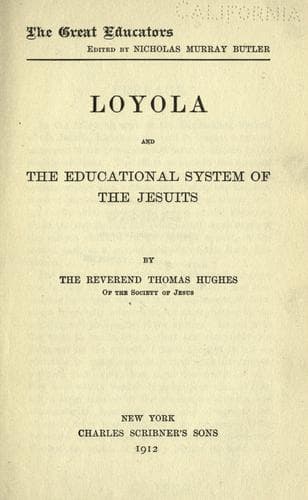
Loyola and the Educational System of the JesuitsHughes, Thomas
History
Loyola and the Educational System of the Jesuits
Hughes, Thomas
Education -- History; Ignatius, of Loyola, Saint, 1491-1556; Jesuits
Half a century later, this question of coördination received a still
fuller treatment at the hands of the General Francis Piccolomini.
After requiring that philosophers and theologians alike finish
conscientiously all the matter assigned for each year, he will not
allow that "the example of authors who have mixed up subjects, or have
followed out their questions into mere minutiæ, can be cited as of any
weight with our Professors. For, whatever is to be thought of them,
this method is not opportune for practical teaching in the schools."
The General scouts the idea of "exploring the treasure-house of
possibilities," to find out new questions; for there is reason to fear
that "while folks search about for truths not ascertained, they will
catch at chimeras and shadows."[283] Hence, as the _Ratio_ prescribes,
"opinions which are useless, obsolete, absurd, manifestly false, are
not to receive treatment." The Professors are to run rapidly through
questions which are easy. In Holy Scripture, difficult passages are
not to be dwelt on indefinitely, nor too much time to be given to
chronological computations, or topological surveys of the Holy Land.
In facing the objection, that all this entails a great expenditure of
thought and matter, when Professors must despatch in such short courses
what might well be treated in longer terms, the preliminary _Ratio_
draws a sharp line of demarcation between other universities and those
conducted by Jesuits. "Whatever is the custom in other universities,
our method is very different from theirs, so that no less progress
can be made in our schools during four years, than in others during
five; because our Professors are for the most part more laborious; we
have more numerous exercises; our Society, as standing in need of many
workmen, requires that perfection of science which is necessary for its
men, not that otiose method of others, who, having no motive of this
kind to make them expeditious, divide up into many lectures what could
well be treated in fewer; their vacations too are for the most part
longer and more frequent."[284]
_Ex ungue leonem_, "You can tell a lion by his paw." Let it appear that
the brevity which you study is necessitated by your limits of time;
let discernment be conspicuous in your selection of matter, whether
to treat summarily or to treat copiously; let the alternate courses
supplement one another, so that what had to be skimmed over in one
quadriennium is dilated upon more at large in your next; then, say the
Fathers, the authority which the Professors enjoy with ecclesiastical
dignitaries will not suffer the detriment anticipated by some, when
we give condensed and accurate treatment in a shorter time of what is
usually spread out through a longer.[285] The paw shows the lion.
Public-domain text, read in full here on John Shaqi.
Reviews
Reviews
No reviews yet
Be the first to share your thoughts on this work.
Elsewhere in the archive
Join the Discussion
Join the discussion
Sign in to leave a comment or review.
Sign InorCreate an account