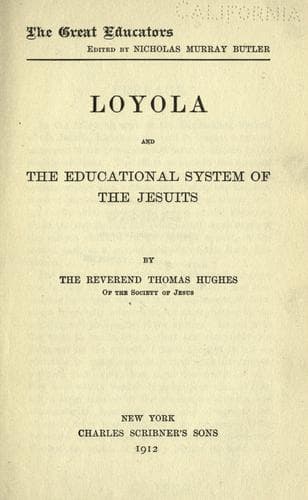
Loyola and the Educational System of the JesuitsHughes, Thomas
History
Loyola and the Educational System of the Jesuits
Hughes, Thomas
Education -- History; Ignatius, of Loyola, Saint, 1491-1556; Jesuits
3. We may proceed now to the typical form of Jesuit instruction.
It is called _prælectio_. This word is largely the equivalent of
"lecturing," in the higher faculties; of "explanation," in the lower.
In either case, however, it is something specific. For this reason, and
because I shall have to use the word often, I may be allowed to put it
in an English dress, and speak of "prelection."
Its form, as a lecture in the higher faculties, is conceived thus: The
whole proposition, which is advanced, is to be delivered consecutively,
without interposing any stoppages. Then it should be repeated in the
same words; and this will be taken by the students as a sign that it
is to be written down; and the delivery of it should be marked by such
inflections, and proceed at such a pace, especially in its obscure and
finer points, that the students may readily distinguish between what
is to be written and what is not. Now, while the proposition is thus
being taken down, the lecturer ought not to advance new ideas, but
should dally with the same, either explaining it in more phrases or
clearer ones, or adducing an example or similitude, or amplifying the
topic, or drawing out the same logical sequence in another order, so
as to make it stand out more distinctly, or throwing out a reason or
two, which, however, it is not necessary for them to note. Indeed, if
the Professor brings his own papers into the school, he might have in
them some select phrases, brief but not obscure, in which he sums up in
few words the gist of the propositions. Longer development they will
receive only in the explanation, which is then to be given.[286] In
that, the Professor will endeavor to prove his thesis, not so much by
the number of arguments, as by their weight. He should not be excessive
in adducing authorities. And it belongs to his dignity, as a Master,
scarcely ever to quote an author whom he has not himself read.[287]
Public-domain text, read in full here on John Shaqi.
Reviews
Reviews
No reviews yet
Be the first to share your thoughts on this work.
Elsewhere in the archive
Join the Discussion
Join the discussion
Sign in to leave a comment or review.
Sign InorCreate an account