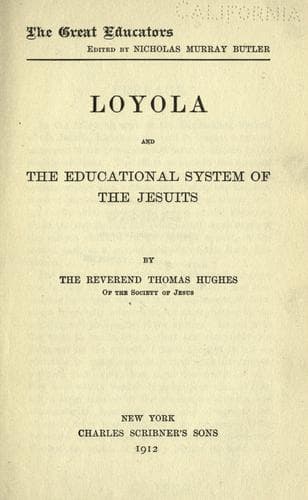
Loyola and the Educational System of the JesuitsHughes, Thomas
History
Loyola and the Educational System of the Jesuits
Hughes, Thomas
Education -- History; Ignatius, of Loyola, Saint, 1491-1556; Jesuits
In the grade of Rhetoric, which is the highest of the literary or
classical course, the prelection is double; one is upon the art of
eloquence, wherein precepts are explained; the other is upon an author,
and has for its object the development of style. Taking up an author
such as Cicero, the Professor will, in the first place, make clear
the sense of the passage. Secondly, the artistic structure is to be
analyzed and demonstrated: the _Ratio_ here details the elements of
this analysis. Thirdly, other passages which are similar in thought or
expression are to be adduced; other orators and poets, whether in the
classics or in the vernacular, are to be cited as employing the same
principles of art, in persuading or narrating. Fourthly, if the matter
allows of it, the thoughts expressed by the author are to be confirmed
by what wise men have said on the same subject. Fifthly, whatever else
will conduce to ornamenting the passage is here in place, from history,
mythology, erudition of every kind. Finally, the words are to be
weighed singly; their propriety of use, their beauty, variety, rhythm
to be commented upon. The whole of this treatment, however, does not
come within the limits of each and every lesson.[288] The "erudition"
for this grade is defined to comprise "the history and manners of
nations, the authority of various writers, and all learning, but
sparingly, to suit the capacity of the scholars."[289]
The prelection on the precepts or rules, "the power of which," says
the _Ratio_, "is very great for the purposes of oratory," comprises
six points. Cicero is the rhetorician who supplies the precepts;
but Quintilian and Aristotle may also be used. First, the meaning
of the rule is to be explained. Secondly, upon the same rule, the
rhetoricians are to be collated. Thirdly, some reason for the rule is
to be expounded. Fourthly, some striking passages from prose writers,
and also from poets, are to be adduced in exemplification of the rule.
Fifthly, if anything in the way of varied erudition makes to the
purpose, it is to be added. Lastly, an indication should be given how
this principle of art can be turned to use by ourselves; the style
in which this is done must be marked by the most absolute choice and
finish of diction possible.[290]
Public-domain text, read in full here on John Shaqi.
Reviews
Reviews
No reviews yet
Be the first to share your thoughts on this work.
Elsewhere in the archive
Join the Discussion
Join the discussion
Sign in to leave a comment or review.
Sign InorCreate an account