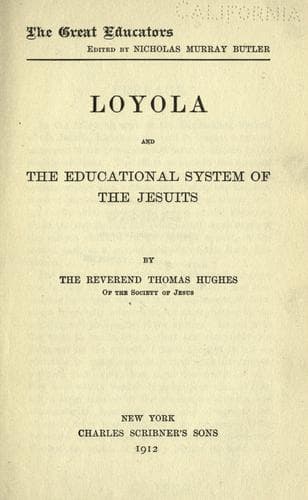
Loyola and the Educational System of the JesuitsHughes, Thomas
History
Loyola and the Educational System of the Jesuits
Hughes, Thomas
Education -- History; Ignatius, of Loyola, Saint, 1491-1556; Jesuits
The grades of Grammar have respectively their own forms of prelection,
given in detail by the final _Ratio_. It will be enough for us to
sketch the general form of the earlier critics.[294]
According as it is a grammar or an author that is being explained, a
very different method of prelection is to be followed. In the grammar,
we acquire a fund of precepts; in an author, a store of words and
phrases. Wherefore, in the books of grammar, the boys must understand
perfectly the things explained; they need not attend scrupulously to
the words there, with a view to forming style. But, in the letters of
Cicero, and other texts of the kind, it is not so much the substance of
the sentences, as the words and phrases that are of chief consequence;
the significance and force of his thoughts are to be reserved for the
higher classes, when the students are no longer mere boys.
In the classes of Grammar then, let the Master follow this method of
explaining Cicero, or any other author. First, he will sketch, in the
briefest way, the meaning of the author, and the connection between
what has gone before and what is now to be explained. Then he will
give a version of the period literally, preserving to the utmost
the collocation of words, as they stand in the author; and also the
figures employed. As to the collocation or arrangement of the words,
this is of such consequence that sometimes, if a single word is put
out of its place, the whole thought seems to lose its force and fall
flat. Herein, too, is perceived that rhythmic flow of the style,
which of itself, even if other ornaments are wanting, pleases the ear
wonderfully and gratifies the mind. Thirdly, the whole period is to be
resolved analytically into its structural elements, so that the boys
understand distinctly what every word governs; and their attention
should be directed to some useful points of good Latinity. As to this
structural analysis, I may be allowed the passing remark, which is
familiar to every judge of a classical education, that the disciplinary
value of literary studies reaches here its highest degree of mental
exercise; and that the two classical tongues, Latin and Greek, are
altogether eminent as supplying materials for this exercise, in their
own native structure; which, in the Latin, is an architectural build,
characteristic of the reasoning Roman mind; and, in the Greek, is a
subtle delicacy of conception and tracery, reflecting the art, the
grace and versatility of Athens and the Ionian Isles.
Public-domain text, read in full here on John Shaqi.
Reviews
Reviews
No reviews yet
Be the first to share your thoughts on this work.
Elsewhere in the archive
Join the Discussion
Join the discussion
Sign in to leave a comment or review.
Sign InorCreate an account