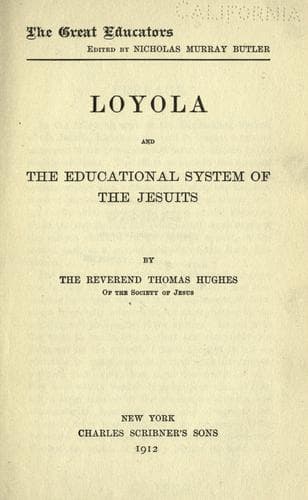
Loyola and the Educational System of the JesuitsHughes, Thomas
History
Loyola and the Educational System of the Jesuits
Hughes, Thomas
Education -- History; Ignatius, of Loyola, Saint, 1491-1556; Jesuits
After this, each word is to be examined, as to what it signifies, and
to what uses it may be applied; the boy is to understand, as far as may
be, the original and proper idea and force of every word, not merely
its general significance, as in a shadowy outline; he should know, too,
the phrases in his native tongue, which correspond with precision and
propriety to the Latin. The metaphors and the figurative use of words,
especially as found in Cicero, are to be explained to the boys in an
extremely plain manner,[295] and by examples drawn from the plainest
objects. Unless this use of words is understood, the true and genuine
knowledge of the tongue is seriously obstructed. Then, picking out
the more elegant turns of style, the Master will dictate them to the
scholars, and afterwards require the use and imitation of these phrases
in their themes. Lastly, he will go back and translate the words of the
author over again, as he did at the beginning; and, if need be, do so a
third and a fourth time.
As to writing, during all this, let him forbid them absolutely to take
down a single letter, except when told. What he does dictate to them,
he is to finish within the time of the prelection, and not prolong
this time for the sake of the writing. It happens now and then that,
with much labor, waste of time, and to no good purpose whatever, the
boys take down, and preserve with diligence, a set of notes which
have not been thought out very judiciously nor been arranged very
carefully,--notes simply trivial, common, badly patched together,
sometimes worse than worthless; and these notes they commit to paper,
in wretched handwriting, full of mistakes and errors. Therefore, let
the dictation be only of a few points, and those extremely select.
The Masters are to be on their guard, lest private tutors at the boys'
homes explain new lessons to them. These tutors have merely to repeat
with the boys what has been heard in class. Otherwise, the fruit of the
good explanation which is received at school is lost at home.
Repetition is now in order. Two principles govern this exercise.
First, "what has often been repeated sinks deeper into the mind."[296]
Secondly, "the industry of youths flags under nothing so much as
satiety."[297] As soon, therefore, as the prelection is over, the
Professor is to require at once an account of all that he has said,
and he is to see that the whole line of his explanation is followed in
the repetition. As if this seemed to imply that only the best scholars
were to be called upon, the critics go on to note that not all of what
has been explained should be repeated by one only, but that as many as
possible should be practised every day. The Master should not follow
the order in which the boys are seated, but take them here and there.
However, the first to be called on are those more advanced; then,
the duller, or perhaps lazier ones, and these should rather be asked
oftener, to be kept up to the mark.[298]
Public-domain text, read in full here on John Shaqi.
Reviews
Reviews
No reviews yet
Be the first to share your thoughts on this work.
Elsewhere in the archive
Join the Discussion
Join the discussion
Sign in to leave a comment or review.
Sign InorCreate an account