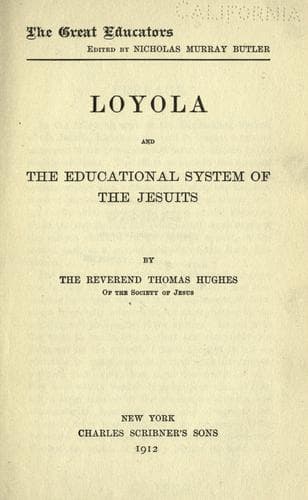
Loyola and the Educational System of the JesuitsHughes, Thomas
History
Loyola and the Educational System of the Jesuits
Hughes, Thomas
Education -- History; Ignatius, of Loyola, Saint, 1491-1556; Jesuits
The final _Ratio_ notes that the daily lesson should not exceed four
lines in the lowest class of Grammar; seven in Middle Grammar. There
is, as I have already observed, a prelection proper to grammatical
rules; also to Greek, whether it be in the grammar or in an author.
Proportion in width and depth of matter is adjusted to each grade.
A careful dictation in the vernacular is to be given, which, when
rendered into Latin or Greek, will exemplify the precepts explained,
or the use of the phrases already dictated. And one part of the school
exercises, from the lowest class up to Rhetoric, is a _concertatio_
between rivals, which is a lively discussion either upon matters
explained in the prelections, or upon one another's compositions. In
this field of debate, as is natural, the activity of the students
grows, both in the extent of the field to be covered, and in the
depth of erudition required, according as the grades are mounted.
And it is carried out of the class-room into select societies,
called "academies," the members whereof, whether grammarians or
_littérateurs_, conduct their debates, give their own prelections or
repeat a choice one of their Professor's, award a place in the archives
to some specially meritorious production; and they conduct all these
exercises in exact keeping with their actual prelections and studies.
Nor do they yield an inch in gravity or dignity to the great academy
of theologians and philosophers.[299]
As to the native tongue, one of the earliest systems of studies in
the Society, prior to the general _Ratio_ by about forty years, lays
down for the middle class of Grammar, that "on Mondays and Wednesdays
the boys will receive the themes in Bohemian and German for their
epistolary exercises."[300] This document is probably from the pen
of Peter Canisius, soon after the colleges were founded at Prague,
Ingolstadt and Cologne. In a directive memorial of 1602, drawn up for
Mayence by Father Ferdinand Alber, a postscript is added to the effect,
"Let exercise in the German tongue be furthered."[301] Jouvancy lays
down the practice in this manner: "After the correction and dictation
of the written exercises, the Latin author is rendered into the mother
tongue, or a _concertatio_ is held. These two exercises can be held
on alternate days, if there is not enough of time every day for both.
In rendering the author into the vernacular, you will observe three
things: first, the idiom of the vernacular, and its agreement in
construction with the Latin, or else its disagreement, so that the
scholars learn each tongue by the other; secondly, the proper turns
and elegance of the Latin style; finally, the thoughts of the author,
as having a moral bearing, and as calculated to form and mould the
judgment of the boys; also the ways of men, the punishments of the
wicked, the maxims of sages. Some part of an historical author should
be given sometimes for their written exercise, to translate into the
Public-domain text, read in full here on John Shaqi.
Reviews
Reviews
No reviews yet
Be the first to share your thoughts on this work.
Elsewhere in the archive
Join the Discussion
Join the discussion
Sign in to leave a comment or review.
Sign InorCreate an account